Table of Contents
1. Introduction: The Birth and Concept of E-Commerce
E-commerce is defined as the process of buying and selling goods and services, and transmitting data over the internet. The concept originated in the 1970s with the emergence of Electronic Data Interchange (EDI), which allowed companies to exchange purchase orders electronically. However, the real breakthrough of e-commerce as we know it today began in 1994 when the first online sale of a music CD took place. Since that moment, the global commercial landscape has been radically transformed, moving from traditional brick-and-mortar stores to digital marketplaces without geographical boundaries.
The first decade of the 21st century witnessed a massive surge with the rise of giant companies that reshaped global commerce, enabling anyone, anywhere, to purchase a product from the other side of the globe with a single click. With the proliferation of smartphones and the development of electronic payment gateways, the market size multiplied to unprecedented levels. Today, e-commerce is no longer a technical luxury but an absolute necessity for any business seeking to survive and thrive in the digital age.
The essence of e-commerce lies in removing barriers between seller and buyer, reducing operational costs, and providing accurate data that helps in understanding consumer behavior. It also offers startups and small business owners a golden opportunity to reach a wide audience without the need for massive investments in traditional infrastructure. According to recent statistics, the global e-commerce volume exceeded 6.9 trillion dollars in 2024, with projections of continued remarkable growth.
In this comprehensive guide, we will cover everything you need to know about creating an online store, from initial planning and choosing the right platform to details of costs, risks, and drawbacks. You will learn about the best available solutions in the market, including the integrated Odoo business management system, and the Salla platform that allows you to create a free online store in the easiest steps, along with other options we will explore in detail. Our goal is to provide you with a practical, comprehensive guide enabling you to make an informed, data-driven decision.
2. History of E-Commerce and Its Evolution to the Modern Era
The first phase spanned from 1969 to 1994, where e-commerce was limited to closed networks among large institutions using the EDI protocol. In 1979, Michael Aldrich invented a television-based shopping system, considered the first interactive electronic shopping model. Then came 1994, witnessing the first encrypted commercial transaction via the Netscape browser, paving the way for the emergence of the first online retail stores like Amazon and eBay the following year.
The second phase (1995-2004) saw the founding of e-commerce giants and the first boom in consumer adoption of online shopping. During this period, secure payment gateways emerged and encryption protocols evolved, contributing to building consumer trust. Traditional stores also began establishing an online presence, giving rise to the "bricks and clicks" model that combines physical and online stores. This phase also witnessed the dot-com bubble burst in 2000, which completely reshaped the sector.
The third phase (2005-2015) was marked by the smartphone revolution and the advent of mobile commerce. With the launch of the iPhone in 2007 and the spread of app stores, consumers started carrying a full store in their pockets. Specialized platforms like Shopify and Magento appeared to facilitate the creation of online stores without requiring deep programming expertise. This phase also saw massive growth in social media, which became a primary marketing channel for online stores.
The fourth phase (2016-2025) is the era of maturity and artificial intelligence, where e-commerce heavily relies on big data analytics and machine learning to deliver personalized recommendations to each user. Technologies like augmented reality emerged, allowing users to virtually try products before purchase, and digital payment solutions and e-wallets proliferated. During the 2020 COVID-19 pandemic, e-commerce took a quantum leap as online sales in several sectors doubled within just a few months.
Now, in 2026, we are on the cusp of a new phase characterized by predictive commerce, where systems can anticipate consumer needs before they express them. Blockchain technologies and digital currencies are also beginning to redefine payment mechanisms and trust in electronic transactions. In the following sections, we will focus on how to leverage these advancements to build your own online store using the best and most cost-effective methods available today.
3. Roadmap to Building a Successful Online Store
Step one: Define your store idea and target products with extreme precision. You must answer fundamental questions such as: What problem does your product solve? Who is your ideal customer? What unique value do you offer compared to competitors? Conduct thorough market research using tools like Google Trends, potential customer surveys, and direct competitor analysis. This stage is the foundation upon which everything else will be built, and any mistake here will cost you dearly later.
Step two: Choose the right business model. There are several primary e-commerce models, such as B2C (business to consumer), the most common; B2B (business to business); C2C (consumer to consumer) like auction platforms; and D2C (direct to consumer), a rapidly rising model. Each model has different requirements regarding pricing strategies, marketing, and logistics. You must also decide whether you will rely on a self-inventory model or dropshipping, which does not require warehousing.
Step three: Select the appropriate technical platform. In the following sections, we will review platforms like Odoo, Salla, and other options in detail, but the fundamental principle is to match the platform's capabilities with your project's current and future needs. Consider factors such as ease of use, scalability, operating costs, and available technical support. Do not be swayed by the cheapest platform if it lacks the features you need, and conversely, do not pay for complex features you won't use in the early stages.
Step four: Prepare content and media. High-quality product images and accurate, persuasive descriptions are the backbone of any successful online store. Invest in professional photography for your products or use graphic design tools to create attractive visuals. Write clear, comprehensive descriptions that include the keywords your potential customers are searching for. Do not forget to set up essential pages like "About Us," "Return Policy," and "FAQ" – these build trust and answer visitor questions.
Step five: Set up payment gateways and shipping. At this stage, you connect your store to the electronic payment gateways suitable for your target audience. For the global market, common options include PayPal, Stripe, and local gateways like cash on delivery and bank transfers. Define shipping policies clearly: Will you offer free shipping? What are your coverage areas? What is the expected delivery time? These details significantly influence the customer's purchase decision.
Step six: Launch the store and ongoing marketing. After ensuring all parts of your store function correctly, launch time comes. However, launch is not the end of the journey but its actual beginning. You need an integrated marketing plan that includes Search Engine Optimization (SEO), paid advertising on social media platforms, and email marketing. Continuously analyze your store's performance using data analytics tools like Google Analytics to make informed decisions.
4. Planning Priorities Before Launching Your Store
Top priority: Define your target audience precisely. Knowing who you are talking to determines everything else: store design, content language, pricing strategy, marketing channels, and even the payment methods you must provide. Use the "Buyer Persona" approach to create a detailed profile of your ideal customer, including their age, location, interests, challenges, and purchasing behavior. Without this knowledge, your efforts will be scattered and ineffective.
Second priority: Ensure an excellent user experience (UX). In e-commerce, every extra click or second of page load delay means losing a percentage of potential customers. Make the browsing, searching, and purchasing process as smooth and intuitive as possible. Ensure your store is responsive across all devices, especially mobile phones, which account for over 70% of global e-commerce traffic. Test your store on different browsers and devices before launching.
Third priority: Build trust and credibility. Customers hesitate to buy from a new store they don't know, so you need trust-building elements such as previous customer testimonials, security badges (SSL), clear return policies, and known secure payment methods. Display contact information clearly and add trust seals from recognized authorities if possible. The more transparent and professional you are, the higher customer trust and, consequently, conversion rates will be.
Fourth priority: Discoverable content. It is not enough for your store to be beautiful; potential customers must find it when they search for your products. Invest in writing SEO-optimized product descriptions and create a blog linked to your store that publishes useful content related to your product niche. This SEO effort is a long-term investment that pays off for years by bringing free, targeted visitors to your store.
5. E-Commerce Website Design | Odoo – The Integrated Solution
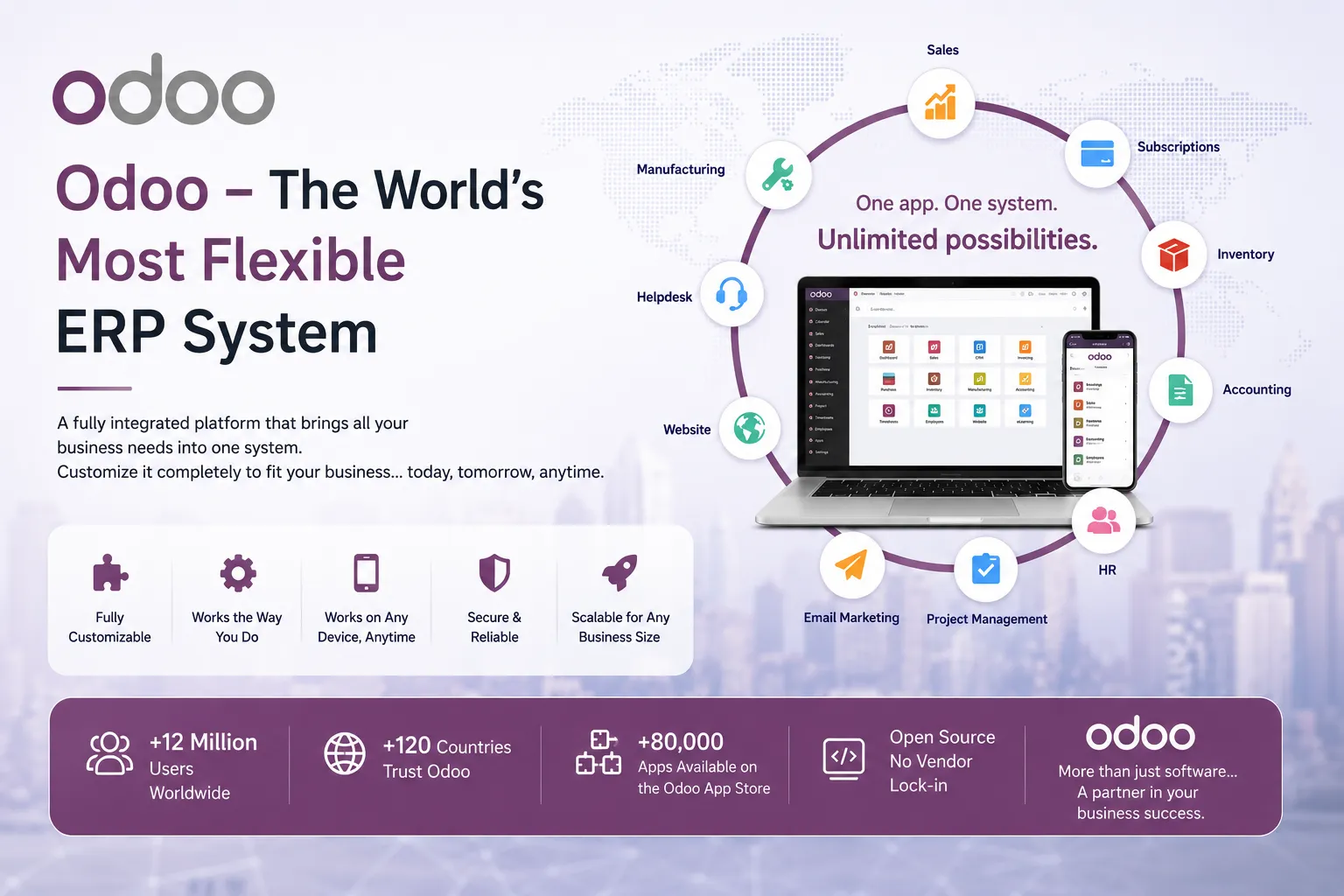
Odoo is an open-source Enterprise Resource Planning (ERP) system that offers a wide range of integrated business applications, including a powerful e-commerce module. Odoo is distinguished by its ability to integrate the online store with other business departments such as accounting, inventory, human resources, and customer relationship management in a single unified platform. This deep integration makes it an ideal choice for companies looking to fully automate their operations rather than just creating a front-end sales interface.
Odoo comes in two main editions: Community, which is completely free and open-source, and Enterprise, which adds advanced features for a license fee. You can design e-commerce websites | Odoo using the built-in drag-and-drop website builder, allowing you to create attractive product pages without writing a single line of code. Odoo also provides an advanced theme editor giving you full control over colors, fonts, and overall layout.
Among Odoo's prominent e-commerce features are advanced inventory management with real-time quantity tracking, automatic invoice generation synced with the accounting system, multi-language and multi-currency support making it suitable for international markets, and integrated analytics tools to monitor sales performance. Odoo also allows creating dynamic pricing rules and applying automatic discounts based on predefined conditions, providing great flexibility in pricing strategies.
Practical example: Suppose you run an electronics store. Using Odoo, when a customer buys a phone from your online store, the system automatically deducts the item from inventory, creates a sales invoice, updates the customer's record in the CRM system, schedules a shipping task in the warehouse module, and records the accounting entry in the general ledger. All this happens in seconds without any manual intervention, reducing errors and boosting operational efficiency.
To utilize the free version, you need to install Odoo on your own server or use a cloud hosting service that supports Odoo. The installation process is relatively straightforward for users with intermediate technical experience, and comprehensive documentation is available on the official Odoo website. After installation, you can activate the e-commerce module from the control panel and start adding your products and customizing your store's appearance. For beginners, managed Odoo cloud hosting services are available for a monthly fee starting around $25.
6. Create a Free Online Store in the Easiest Steps – Salla Platform
Salla is an Arab-origin cloud e-commerce platform designed specifically to meet the needs of the Arab market. It features a simple, user-friendly interface that makes creating a free online store in the easiest steps – Salla Platform accessible to everyone, even those with no technical background. All you need is an account on the platform and a few minutes to be ready to receive orders. Salla fully supports the Arabic language and provides payment gateways compatible with Arab markets.
The process begins by visiting the official Salla website and creating a new account using your email. After activating your account, you are taken directly to an easy-to-use control panel where you can choose the right template for your store from dozens of professional ready-made templates. Salla offers a free plan that allows you to add an unlimited number of products and start selling immediately, with full support for major payment gateways in the Arab region.
The Salla platform handles all technical complexities for you: store hosting, SSL security certificate, system updates, and backups. All you need to focus on is adding your products, writing their descriptions, and setting their prices. The platform also supports creating discount codes, managing promotional offers, and sending marketing messages to customers. Among Salla's powerful features is integration with Arab shipping companies, making shipping and delivery management easier.
Application example: Suppose you have a home-based project making scented candles. Using the Salla platform, you can, in just 15 minutes, create an online store showcasing your products with beautiful images and clear prices. Customers can browse the store from their phones, choose the candles they like, and complete the purchase using their bank card or choose cash on delivery. You receive an instant notification of the order and start preparing it for shipment, all without paying any fees on the basic plan.
To scale up your use of Salla, the platform offers paid plans starting at reasonable monthly fees, adding advanced features such as removing Salla branding, adding your own domain, advanced analytical reports, and more third-party integrations. However, even with the free plan, the store remains fully functional and capable of generating real sales, making Salla an excellent choice for entrepreneurs in the testing and launch phase.
7. Create Your Online Store in Minutes and Easily
In the age of cloud platforms, the slogan "create your online store in minutes and easily" has become a reality, not just an advertisement. Modern platforms have developed setup wizards that guide you step by step through the creation process. You start by choosing the store name, then specifying the sector you operate in, selecting a template from the suggested ones, and then adding your first product. In less than 10 minutes, your store can be ready to receive visitors.
Speed does not mean sacrificing quality. The ready-made templates provided by these platforms are designed by professionals, adhering to best practices for user experience and search engine optimization. These templates are also automatically responsive to all screen sizes, ensuring your store looks professional on desktop, tablet, and mobile alike. You can later customize colors, fonts, and images to match your brand identity.
A real-world example of this ease: Imagine you wake up one morning and decide to sell a collection of used books. You open your computer, create an account on one of the free e-commerce platforms, upload book photos, write a brief description for each book, set prices, and activate the store. By lunchtime, your store is published on the internet and anyone can buy from it. This scenario was impossible 10 years ago without hiring a professional web developer and incurring high costs.
8. Create a Professional Free Online Store – Is It Really Possible?
Creating a professional free online store is a goal many strive for, and the key question is: can "free" and "professional" coexist? The short answer is: yes, but with some considered compromises. Today's free solutions offer a high level of professionalism in design and functionality, but they usually impose some limitations such as displaying their branding in the store footer, capping the number of products allowed, or not supporting your own domain name.
To get a truly professional free store, you need to use open-source solutions like WooCommerce, built on the WordPress system. These solutions are completely free in terms of licensing, but they require you to pay for hosting and a domain name – costs that are unavoidable for any website (starting from about $5/month for shared hosting and $10/year for a domain). The big advantage here is absolute freedom in customization and no limits on the number of products or sales.
Practical comparison example: Using free WooCommerce with hosting costing $6 per month, you can create a fully professional online store with your own domain without any third-party branding, with the ability to install free plugins to improve performance, SEO, and shipping management. This store will be identical in appearance and functionality to stores paying hundreds of dollars monthly on proprietary platforms, with the difference that you will need to put in more effort during initial setup and ongoing maintenance.
9. Create a Lifetime Free Online Store in 5 Minutes (No Commission)
The phrase "create a lifetime free online store in 5 minutes (no commission)" represents the ideal offer that new entrepreneurs seek. The truth is, some platforms do offer this, but you must read the fine print carefully. Platforms like Salla, in their free plan, allow you to create a store and keep it free forever without a commission on sales, as their business model relies on offering paid plans with extra features rather than taking a cut of your profits.
What "no commission" means here is that the platform does not deduct a percentage from each sale you make, unlike some other platforms that charge a commission ranging from 2% to 5% per transaction. However, note that the payment gateways themselves (like Visa and Mastercard) charge their own processing fees, typically ranging from 2.5% to 3.5%, which are unrelated to the platform. Also, some platforms may charge withdrawal fees or fees for exceeding a certain monthly sales threshold.
A real-life example: A female entrepreneur set up a store on a platform offering a lifetime free plan with no commission. In her first month, she sold products worth $800. The platform deducted no commission from this amount. She only paid the payment gateway processing fee (about $23.20 at a 2.9% rate). Her net profit was significantly higher than if she had used a platform that deducts an additional 5% commission (she would have lost an extra $40). In the long run, saving on commission makes a big difference in the project's profitability.
To make the most of these offers, look for platforms that combine a lifetime free plan, zero commission, and support for your target market. Be sure to read the terms of service carefully to understand any potential limits on product numbers, storage volume, or monthly visitors. Most importantly, choose a platform that allows you to upgrade to a paid plan later without losing your data or having to rebuild your store from scratch when your project grows.
10. How to Create an Online Store in Egypt? (Case Study)
The question "How to create an online store in Egypt?" is one of the most frequently discussed topics among Egyptian entrepreneurs. The Egyptian market has its own peculiarities that must be considered when creating an online store. First, the Egyptian audience heavily prefers the cash on delivery (COD) option, with statistics indicating that over 70% of e-commerce transactions in Egypt are completed in cash upon delivery. Therefore, your platform must support this option fundamentally.
Second, you need integration with shipping and delivery companies operating in the Egyptian market. Some Arab platforms like Salla offer ready-made integrations with these companies, saving you the hassle of manual setup. You should also consider that shipping costs within Egypt are relatively reasonable inside major cities but increase when delivering to remote governorates, which should be reflected in your shipping policy.
Third, regarding electronic payment gateways in Egypt, available options include Paymob, Fawry, PayFort, and Opay. These gateways usually require a commercial register and tax card for companies, though some offer solutions for individuals and startups. The registration process can take from one to three weeks, so start early and don't wait until your store is complete. You can initially rely on cash on delivery only and then add electronic payment later.
Case study: An Egyptian young man launched a store selling natural skincare products via the Salla platform using its free plan. He initially focused only on the local market in Greater Cairo to reduce shipping costs. He used cash on delivery as the sole option for the first two months until he built a base of loyal customers. After that, he registered with an electronic payment gateway and added card payment options. Within one year, he expanded to all Egyptian governorates, and his monthly sales reached approximately $1,200. His success secret was understanding the specificity of the Egyptian market and not blindly copying a Western model.
11. Best Site to Create a Free Online Store?
The answer to "Best site to create a free online store?" depends on your specific needs. No single solution fits everyone. Here is an objective comparison: Salla is best for the Arab user who wants simplicity and integration with the local market. Shopify offers a free trial but is paid afterward, and excels with ultra-professional templates. Wix allows creating a free store with a subdomain and platform ads, suitable for very small projects.
WooCommerce on WordPress is the best in terms of flexibility and full control, and while the software itself is free, you need hosting and a domain. BigCommerce offers a limited free plan but is rich in built-in features that require paid add-ons in other solutions. Ecwid allows you to add a store to your existing site for free with the ability to sell on social media, an excellent option if you already have a site and want to add store functionality.
If you specifically target the Arab market, Salla tops the list deservedly due to its full Arabic support, local payment gateways, and integration with regional shipping companies. If you target a global market, Shopify or WooCommerce might be better options. And if you are looking for an integrated solution to manage your entire business, not just the store, Odoo is the ideal choice. The key is to define your priorities precisely first and then match them with each platform's features.
Practical tip: Don't spend weeks comparing platforms theoretically. Choose two or three platforms that seem suitable, and create a free trial store on each (most offer trial periods or free plans). Try adding 5 real products, test the purchase process yourself, and compare ease of use and final appearance. This hands-on experience will reveal much that feature and pricing pages don't tell you and help you make a confident decision.
12. How Much Does It Cost to Create an Online Store?
The question "How much does it cost to create an online store?" doesn't have a single answer because it depends on several variables. At the minimum, you can create a completely free online store using a free plan from a platform like Salla or Ecwid, but you will operate on a subdomain and the platform's branding will appear. This zero cost is suitable for testing a product idea or starting a side project without financial risk. In this scenario, your only costs are your time and effort.
The next level is the semi-professional store, with costs ranging from $50 to $200 annually. This cost includes a custom domain name ($10-$15/year), shared hosting ($60-$120/year), and perhaps a paid template or one premium plugin. Using WordPress and WooCommerce, you can build a fully professional store within this budget. This option suits small businesses needing an independent identity and professional online presence.
The full professional level costs between $500 and $5,000 annually, including a paid e-commerce platform like Shopify ($29-$299/month), specialized apps and plugins, a custom professional template, SEO services, and marketing/automation tools. At this level, you get premium technical support, advanced analytics tools, and the ability to scale without technical limitations, suitable for serious projects expecting rapid growth.
The enterprise level, using solutions like Odoo Enterprise, Salesforce Commerce Cloud, or SAP Hybris, exceeds $10,000 annually. These solutions offer deep integration with enterprise systems, complete customization, and the ability to handle millions of products and hundreds of thousands of daily orders. This level is dedicated to large companies and institutions needing enterprise-grade solutions with governance, security, and regulatory compliance.
To compare the different levels, here are approximate first-year costs for each: Zero level (completely free): $0. Basic level: $100-$200. Intermediate level: $500-$1,500. Advanced level: $2,000-$5,000. Enterprise level: $15,000-$50,000. Note that these costs only cover the technical aspect and do not include product costs, marketing, shipping, or taxes.
13. What Are 5 Disadvantages of E-Commerce? (Pro/Con)
With all the advantages e-commerce offers, it's important to be realistic and recognize the other side. The question "What are 5 disadvantages of e-commerce?" is essential for anyone considering entering this field. Disadvantage one: the absence of direct sensory interaction with the product. The customer cannot touch the fabric, try on a shoe size, or smell a perfume before purchasing. This sensory gap leads to high return rates that can reach 30% in some categories like apparel, compared to only 8% in traditional stores.
Disadvantage two: fierce competition and shrinking profit margins. In an online store, your competitors are not just neighboring shops but every store in the world selling the same product. This creates immense price pressure and forces you to compete in other areas like delivery speed or customer service quality. A recent statistic indicates that 90% of new online stores fail within the first 120 days due to an inability to compete on price or differentiate sufficiently.
Disadvantage three: ongoing technical and security challenges. An online store operates 24/7, and any technical failure means immediate loss of sales. Additionally, cyber threats like hacking, customer data theft, and DDoS attacks pose a real risk. You must continuously invest in cybersecurity, regularly update the platform and plugins, and perform periodic backups. All this requires time, expertise, or additional cost to hire specialists.
Disadvantage four: shipping and logistics complexities. Managing the supply chain, warehousing, packaging, and shipping is no easy task, especially when scaling. Delayed shipping, damaged goods during transit, or high delivery costs can ruin the customer experience and lead to negative reviews. Dealing with multiple shipping companies, tracking shipments, and managing returns consumes significant time and resources – challenges a traditional store owner does not face with the same complexity.
Disadvantage five: difficulty in building initial trust and credibility. In a physical store, having a storefront on a commercial street gives you instant credibility. In the digital world, you start from zero. Customers hesitate to buy from a new store with no reviews or established reputation. Building this trust takes a long time and requires a comprehensive strategy including collecting reviews, displaying customer testimonials, providing clear return guarantees, and building a strong presence on social media.
However, for each of these disadvantages, there are solutions and strategies that can be implemented. The lack of sensory interaction can be mitigated through high-resolution images, explanatory videos, and generous return policies. Fierce competition forces you to excel in customer service or product customization. Technical challenges can be eased by using managed services. Shipping complexities are solved through integration with specialized logistics companies. And building trust is achieved through patience, consistency, and delivering real value to customers.
14. Risk Analysis in an E-Commerce Project
Every business project carries inherent risks that must be identified in advance to develop mitigation plans. Risks in e-commerce fall into four main categories. Category one: market risks, including changing consumer trends, entry of new competitors, or market saturation with the product you sell. To mitigate these, continuously monitor market trends, diversify your income sources, and be ready to pivot your strategy quickly.
Category two: operational risks. These include supply chain issues, stockouts during peak seasons, shipment delays, and order fulfillment errors. You can mitigate these by building relationships with multiple suppliers, maintaining a strategic safety stock, using precise inventory management systems, and establishing clear quality control procedures before shipping.
Category three: financial risks. These encompass currency fluctuations if you sell internationally, rising shipping costs, changes in payment gateway fees, and cash flow problems. To mitigate, maintain a cash reserve covering 3-6 months of operating expenses, monitor your financial indicators monthly, and do not rely on a single payment gateway to avoid sales stoppage in case of a technical issue.
Category four: legal and regulatory risks. These include consumer protection laws, data protection regulations like the European GDPR and their equivalents in Arab countries, tax obligations such as VAT, and business license requirements. Consult a lawyer specialized in e-commerce to ensure your compliance with all local and international laws applicable to your business activity.
15. Latest E-Commerce Statistics
According to a report by eMarketer, global e-commerce volume reached $6.9 trillion in 2024, with projections exceeding $8.1 trillion by the end of 2026. China holds the largest share at 38% of total global sales, followed by the United States at 21%, then Europe at 17%. In the Middle East and North Africa region, the sector grew by 22% in 2024 alone, surpassing $50 billion for the first time.
Regarding consumer behavior, Statista figures show that 77% of online shoppers abandon their shopping cart before completing the purchase. The main reasons for abandonment are: unexpected shipping costs (48%), need to create an account (24%), long or complex checkout process (22%), and lack of trust in credit card information (18%). These numbers highlight the importance of simplifying the checkout process and clearly displaying shipping costs early.
In terms of mobile commerce (m-commerce), it accounted for 73% of total e-commerce sales in 2025. This means more than 7 out of 10 purchasing transactions happen via smartphones. Even more striking is that the conversion rate on mobile is still 30% lower than on desktop, indicating a significant opportunity to improve the mobile user experience.
Regarding store setup costs, a survey by Website Builder Expert found that 38% of small online store owners spent less than $500 to create their stores, 27% spent between $500 and $2,000, and 20% spent over $5,000. Interestingly, stores that spent in the mid-range ($500-$2,000) achieved the highest return on investment in the first year compared to the other categories.
16. Practical Simulation: A Day in the Life of a New Store Owner (Roleplay)
Let's live together a realistic scenario of a full day in the life of someone who just launched their online store. Let's call him "Alex." 8:00 AM: Alex checks his store dashboard to find 3 new orders that came in overnight. He smiles as he sees that one customer left a 5-star positive review. He starts preparing the orders: prints invoices, carefully packs the products, and prepares them for the shipping company that will pick them up at noon.
10:00 AM: Alex opens his store analytics tools to see where visitors are coming from. He notices that 60% of new visitors came from a social media post he published two days ago about his new product. He decides to invest more in this type of content. He writes a new post featuring an attractive image and a short story about how to use the product, scheduling it for the evening when his target audience is most active.
1:00 PM: Alex receives a message from a customer asking about the size of a specific product. He replies within 10 minutes with precise information and an illustrative size chart. The customer thanks him and makes the purchase immediately. This experience reminds Alex of the importance of fast customer service, so he considers activating automatic replies for common questions to save time while maintaining response speed.
4:00 PM: Alex holds a 30-minute brainstorming session focusing on one question: How can he improve his store? He writes down 12 ideas ranging from adding product videos, to creating a customer loyalty program, to collaborating with influencers in his niche. He ranks the ideas by priority, cost, and expected impact, and chooses two to implement in the coming week: adding a video for each product, and sending a personalized thank-you email to every new customer.
7:00 PM: Alex reviews the day's performance. 5 new orders, 3 positive reviews, 120 unique visitors, and a conversion rate of 4.1% (excellent compared to the industry average of 2.5%). He feels a sense of accomplishment but knows the journey is long. He plans for tomorrow: researching a new product to add, and studying the possibility of expanding to a new city. He shuts down his computer at 8:00 PM, grateful for the flexibility e-commerce gives him in managing his time.
17. Frequently Asked Questions (FAQ)
Can I create an online store without a business license?
Yes, many platforms like Salla and Shopify allow you to create a store and start selling without a business license initially. However, in the long term, you will need a business license to fully handle electronic payment gateways, open a business bank account, and comply with legal and tax requirements. Requirements vary by country, so consult a local legal expert.
What is the difference between a self-hosted store and a cloud platform?
A self-hosted store like WooCommerce means you own the software and install it on your own server, giving you full control and unlimited flexibility, but you are responsible for maintenance, security, and updates. A cloud platform (SaaS) like Salla and Shopify means the platform hosts your store and manages all technical aspects for a monthly fee, making things easier technically but limiting your customization flexibility.
How long does it take for my store to appear in Google search results?
Indexing your store in Google may take from 3 days to 4 weeks after submitting the sitemap to Google Search Console. However, appearing in top positions for competitive keywords takes months of continuous SEO work. New stores typically start seeing tangible SEO results after 6-9 months of consistent effort.
Can I sell digital products in an online store?
Yes, most e-commerce platforms support selling digital products like e-books, courses, software, and designs. These products have a major advantage: no storage or shipping needed, and they are delivered automatically to the customer after purchase. Ensure your platform supports this feature and has mechanisms to protect files from unauthorized sharing.
18. The Future of E-Commerce
The future of e-commerce is shaping around several key trends that will change the way we buy and sell over the next five years. First, predictive commerce powered by artificial intelligence: stores will be able to predict what a customer wants before they even search for it, offering ultra-precise recommendations based on behavior and current context analysis. This will transform stores from reactive platforms into proactive systems that anticipate and meet needs in real time.
Second, augmented reality (AR) will become a standard, not an extra feature. Customers will expect to virtually try products: trying on glasses on their faces, seeing furniture in their rooms, and even testing wall paint colors. Companies that don't provide these experiences will lose significant market share. Third, voice commerce via voice assistants will experience huge growth as voice recognition accuracy and natural language processing improve, opening a completely new sales channel.
Fourth, blockchain technologies will redefine trust in e-commerce. Smart contracts will automate payments and delivery, and supply chains will become fully transparent, allowing customers to track a product's journey from factory to doorstep. Fifth, social commerce will deepen further as social media platforms become full-fledged stores, not just marketing channels. Live streaming with instant purchase capability is already a phenomenon in Asia and will spread globally.
19. Trusted References and Sources
- Odoo Official Website — Open Source ERP System
- Salla Platform — E-Commerce for the Arab Market
- Statista — Online Shopping Statistics Worldwide
- eMarketer — Global Ecommerce Forecasts and Trends
- WooCommerce — Open Source E-Commerce on WordPress
- Google Search Central — SEO Starter Guide
- Shopify Research — Global Commerce Trends and Data
Summary: Building a successful online store in 2026 no longer requires huge budgets or advanced technical skills. With proper planning, the right platform choice, and an understanding of your target market's specifics, you can confidently launch and grow a profitable digital business.