Costco Hot Dog Combo Options: The Complete Guide to America's Most Iconic Food Court Deal
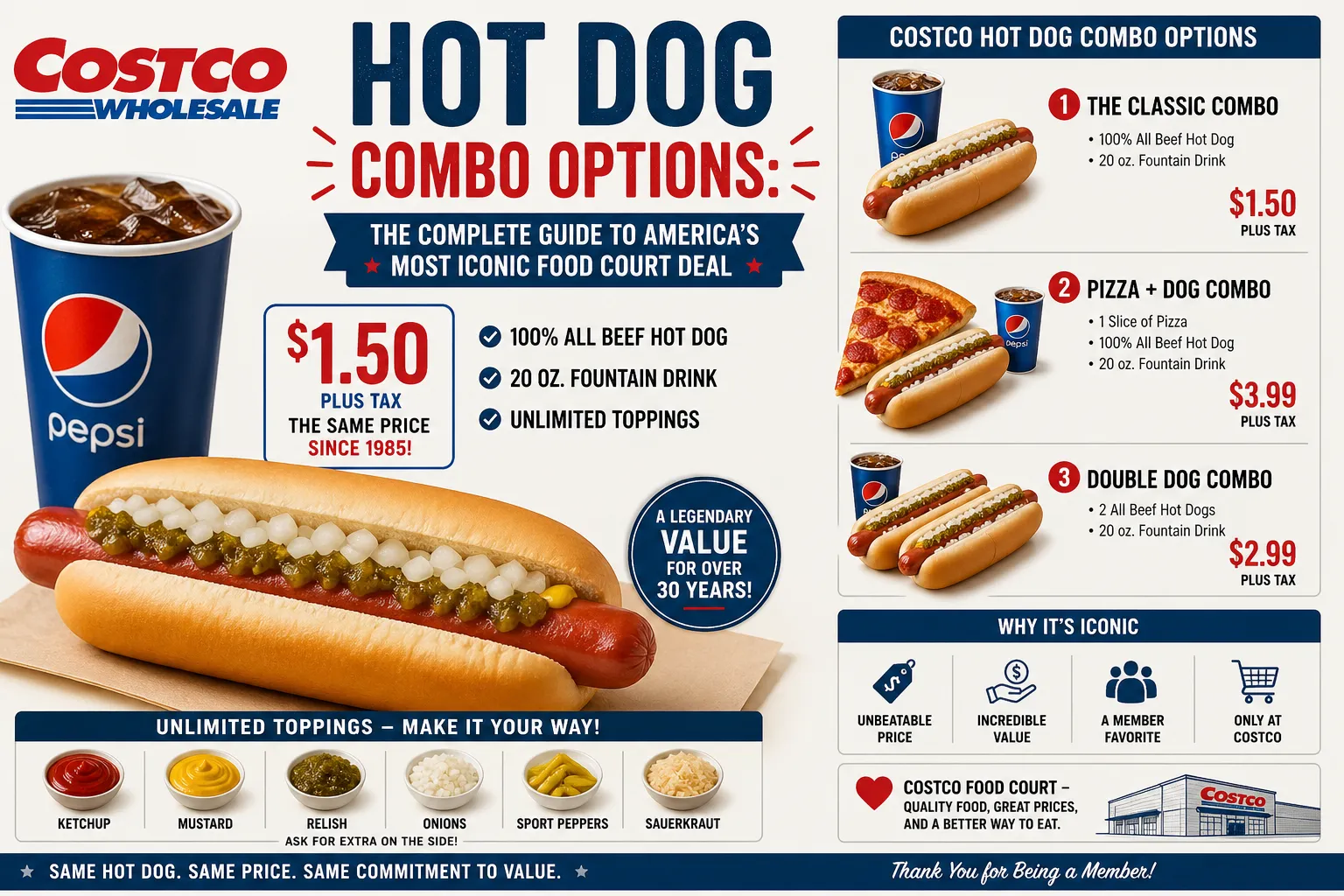
Few items in the history of American retail have achieved the cultural status of the Costco hot dog combo. At a price frozen at $1.50 since 1985 — a figure that would translate to roughly $4.55 in today's dollars when adjusted for inflation — this quarter-pound all-beef hot dog and fountain drink deal has outlasted economic recessions, global supply disruptions, and four decades of rising food costs without a single price increase. This article examines every dimension of the combo in detail: its precise history, the drink and topping options available, its full nutritional breakdown, the latest 2025 changes, customisation strategies, international variations, and the economic philosophy that keeps it at $1.50 when everything else keeps rising.
1. Introduction: Why the Costco Hot Dog Combo Matters
The Costco hot dog combo is not merely a food court item. It is a case study in retail strategy, brand identity, and the remarkable power of a fixed price point sustained across four decades of inflationary pressure. In 2025 alone, customers purchased 245 million units of this combo — a figure that surpasses the total hot dog sales of every Major League Baseball stadium in the United States combined and represents a number that very few individually priced menu items anywhere in the world come close to matching.
Understanding the combo in full means understanding far more than just what comes on the tray. It means examining the drink options available to you at the fountain machine, the complete self-serve toppings station that allows free customisation at no additional cost, the 2025 addition of a bottled water alternative to soda, the summer 2025 switch back to Coca-Cola products after twelve years of Pepsi, and the nutritional realities of a meal that the menu board lists as anywhere between 580 and 850 calories depending on your choices.
This guide addresses all of those dimensions in the depth they deserve. Whether you are a first-time Costco member planning your first food court visit, a regular shopper who wants to understand the combo's history and recent changes, or simply someone curious about why this particular $1.50 deal has generated decades of genuine public fascination, this article provides the most complete and accurate account available.
One point deserves emphasis at the outset: the Costco food court is accessible to members at all times, but non-members can typically access the food court through the warehouse's exit path at many locations in the United States. This means the hot dog combo is available to a broader audience than the membership alone, which has further expanded its cultural reach well beyond the Costco member base.
2. The Complete History: From 1984 to 2025
The 1984 Debut: A Hot Dog Cart in San Diego
The Costco hot dog made its first appearance in 1984, just one year after Costco itself opened its doors in 1983. The original format was not a food court at all but a hot dog cart positioned outside a Costco location in San Diego, California. The hot dogs at this stage were sourced from Hebrew National, a well-known kosher hot dog brand with a strong reputation for all-beef quality. The $1.50 price point that would define the combo for the following four decades was formalised in 1985, making 2025 precisely the 40th anniversary of the price that has never moved.
Building In-House Production Capacity (2004 – 2011)
As the combo's volume grew dramatically, Costco recognised that dependence on an external supplier created both cost vulnerability and quality risk. A Costco meat processing facility in Tracy, California had been in operation since 2004, and in 2011 it was equipped and certified to begin producing hot dogs in-house under the Kirkland Signature brand. This strategic shift simultaneously reduced supply chain costs and gave Costco complete control over the product's specifications, ingredients, and consistency. The switch to in-house production also meant moving from kosher Hebrew National beef to non-kosher beef, which further lowered ingredient costs and gave Costco additional flexibility in its sourcing arrangements.
The Coca-Cola to Pepsi Switch of 2013
By 2013, the relentless cost pressure of maintaining the $1.50 price point required creative financial management. Then-CEO Craig Jelinek approached co-founder Jim Sinegal with a proposal to raise the combo price to $1.75, to which Sinegal responded with a now-legendary refusal. Rather than raising the price, Jelinek found an alternative solution: switching the fountain drink supplier from Coca-Cola to Pepsi, which delivered the cost savings needed to keep the $1.50 price intact. This decision preserved the combo's economics for the following twelve years without touching the price consumers saw on the board.
The Morris, Illinois Facility Opens (2018)
Volume growth continued accelerating, and by 2018 the Tracy, California facility alone could not meet demand. Costco opened a second hot dog production facility in Morris, Illinois that same year, providing geographic redundancy and additional capacity. The two-facility setup gave Costco the operational scale to serve the hundreds of millions of units sold annually without supply disruption, while also reducing the transportation costs associated with shipping finished hot dogs from a single West Coast location to warehouses throughout the entire United States.
The 2025 Milestones: Coca-Cola Returns and Volume Records
In January 2025, Costco CEO Ron Vachris confirmed that the company would revert its food court fountain drink supplier back to Coca-Cola, reversing the 2013 Pepsi switch. The transition was completed across every Costco club by the end of summer 2025. The same year set a new sales volume record for the combo, with 245 million units sold — a 45% increase from the 135 million annual average reported as of 2018, reflecting both membership growth and the combo's sustained pull on customer behaviour.
3. What Exactly Is Included in the $1.50 Combo?
The core components of the Costco hot dog combo are precisely defined and have remained structurally unchanged for decades, even as individual elements within them have evolved. At its foundation, the combo includes a quarter-pound (110-gram) all-beef hot dog produced under the Kirkland Signature brand, served on a steamed bun. The bun type varies by location — some warehouses serve the hot dog on a sesame seed bun, while others use a plain white bun. Both are standard hot dog bun sizes appropriate for the quarter-pound wiener.
The second component is a 20-ounce (590 mL) fountain drink from the self-serve soda station, with free refills available for the duration of your visit. As of summer 2025, the fountain drinks at all US Costco locations are sourced from Coca-Cola, following the company-wide transition back from Pepsi that was confirmed by CEO Ron Vachris in January of that year. This means the standard soda lineup now includes classic Coca-Cola products across the drink selection.
The third and often overlooked component is access to the self-serve toppings and condiments station at no additional charge. Every topping at this station — ketchup, yellow mustard, pickled relish, chopped raw onions, and sauerkraut where available — is provided free with the combo. This station is the primary mechanism through which customers personalise their combo, and it represents a genuine differentiation from fast food competitors who frequently charge for condiments or restrict access to them.
As of late 2025, a fourth variant has been added to the combo structure: the option to substitute the fountain drink for a 16.9-ounce Kirkland Signature bottled water at the same $1.50 price point. This addition marks the first structural change to the combo in four decades and has generated meaningful public debate about its value relative to the original soda option, which will be examined in detail in a dedicated section of this article.
4. Drink Options: Soda, Water, and Everything in Between
The drink component of the Costco hot dog combo offers considerably more choice than its single-price structure suggests. At the fountain machine, customers can fill their 20-ounce cup with any of the Coca-Cola products stocked at their specific location. While the exact lineup varies slightly by warehouse, the standard selection following the 2025 Coca-Cola return typically includes Coca-Cola Classic, Diet Coke, Sprite, Fanta Orange, Minute Maid Lemonade, and Powerade variants. Locations may also stock additional Coca-Cola products depending on regional preferences and contract specifics.
One option that has always existed but is often overlooked is filling the soda cup with plain water from the fountain machine's water dispenser. Every Costco fountain station includes a dedicated water spigot, and customers have always been free to use it as their beverage of choice within the combo — at no difference in price. This means the hot dog and water combination has technically been available since the combo's earliest days, long before the formal bottled water option was introduced.
The caloric impact of your drink choice is substantial and directly determines where your combo falls within the menu board's stated range of 580 to 850 calories. Choosing a regular Coca-Cola adds approximately 240 to 260 calories and around 65 to 70 grams of sugar to the hot dog's base calorie count. Choosing Diet Coke or another zero-calorie diet option keeps the beverage contribution to essentially zero calories. Choosing plain water — whether from the fountain or in bottled form — eliminates the sugar entirely and keeps the full combo at its base calorie level of approximately 580 calories.
The 20-ounce fountain drink comes with free unlimited refills, a benefit that does not carry over to the bottled water option. This distinction is practically significant for customers who sit down for a meal rather than eating on the go, and it represents one of the concrete value differences between the two drink variants within the same $1.50 combo price.
5. The 2025 Return to Coca-Cola: What Changed
The decision to switch back to Coca-Cola after twelve years of Pepsi products represents a significant operational and brand statement from Costco. Costco CEO Ron Vachris confirmed the change in January 2025 with the following announcement: "This summer, we will be converting our food court fountain business back over to Coca-Cola." The transition was executed systematically across all warehouse clubs and was completed by the end of summer 2025, making it a fully accomplished change that current visitors to US Costco food courts will experience as the default.
The practical implication for customers is a change in the available drink brands at the fountain. Where Pepsi, Diet Pepsi, Mountain Dew, and other PepsiCo products previously filled the machine, Coca-Cola Classic, Diet Coke, Sprite, and other Coca-Cola Company products now occupy those positions. For customers who had no strong preference between the two cola brands, the experience is largely unchanged. For those with brand loyalty to one company or the other, the shift is a meaningful one that affects their personal enjoyment of the combo.
The financial motivation behind reverting to Coca-Cola was not publicly disclosed in the level of detail that the 2013 Pepsi switch was. In 2013, the Pepsi switch was explicitly framed as a cost-saving measure needed to preserve the $1.50 price. The 2025 Coca-Cola return has not been explained in the same terms, which suggests it may reflect factors beyond pure per-unit cost — potentially including consumer preference data, negotiated contract terms, or a broader strategic relationship between the two companies that Costco has chosen not to detail publicly.
One practical note worth flagging: as Costco transitions its entire fountain infrastructure to Coca-Cola products, calorie counts for the fountain drink portion of the combo may shift slightly from the values that applied during the Pepsi era. Customers who track their dietary intake with precision should verify the specific nutritional values of the Coca-Cola products now stocked at their local Costco using the most current nutrition information available from Coca-Cola's official resources.
6. The New Water Bottle Option: A 2025 Controversy Explained
In late 2025, Costco began rolling out a new variant of the hot dog combo that allows customers to substitute the 20-ounce fountain drink for a 16.9-ounce Kirkland Signature bottled water at the same $1.50 price. This modification — visible on the self-serve kiosk ordering screens at participating locations — was spotted and shared widely on social media, igniting a debate among Costco shoppers that captures a genuine tension between the two options' respective value propositions.
The central objection raised by shoppers is a straightforward arithmetic one. A standalone Kirkland Signature bottled water at Costco's food court vending machines typically costs $0.25. If the hot dog alone is worth significantly more than $1.25 — which it clearly is, given that it is a quarter-pound all-beef sausage — then paying the same $1.50 for a hot dog plus a $0.25 bottle of water represents a less favourable exchange than paying $1.50 for a hot dog plus a 20-ounce refillable soda. Multiple social media commenters made exactly this point, with one Instagram user summarising it as: the water combo should logically cost $1.25, not $1.50.
There are, however, genuine advantages to the bottled water option for a specific subset of customers. The resealable cap makes it practical for customers who want to take their drink with them as they leave the warehouse rather than consuming it at the food court. It also appeals to customers who do not drink soda for dietary or health reasons and who, prior to this change, had to ask staff for a water cup or use the fountain's water dispenser — a workaround that worked perfectly well but felt less official. Some customers have also cited preference for sealed water over a shared fountain nozzle on hygiene grounds.
The practical downside beyond price perception is volume. The bottled water option delivers 16.9 ounces compared to the fountain drink's 20 ounces with free unlimited refills. For customers who sit down for a meal and would typically refill their cup once, the bottled water delivers materially less liquid for the same price. The absence of refill eligibility for the bottled option is a concrete disadvantage that the fountain drink — regardless of which brand fills it — does not share.
7. The Self-Serve Toppings Station: Every Option Available
The self-serve condiments and toppings station is an integral and free component of the Costco hot dog combo experience. Every US Costco food court maintains a dedicated condiment area where customers apply their chosen toppings after receiving their hot dog. Understanding what is available at this station and how each topping affects the flavour profile and nutritional content helps you build the combination that best suits your preferences.
Yellow mustard is the nutritional champion of the toppings selection. It adds vivid tang and sharpness to the hot dog's savoury beef flavour with virtually no caloric contribution — approximately 5 calories per teaspoon — and is the near-universal recommendation from nutrition-conscious food writers as the go-to topping for those managing their intake. Its vinegar base cuts through the richness of the beef and fat in the hot dog itself, providing a flavour contrast that works particularly well with the all-beef Kirkland Signature wiener.
Ketchup is the most commonly applied topping across all age groups. It adds sweetness and a tomato-based acidity that complements the savoury hot dog, though it carries a higher sugar and calorie content than mustard — approximately 15 to 20 calories per tablespoon — and can add a notable amount of sodium in generous quantities. Pickled relish provides a combination of sweetness and brine that offers textural variety alongside the smooth wiener surface, and pairs particularly well with mustard in a Chicago-style application.
Chopped raw onions are one of the most nutritionally beneficial additions at the station. They add crunch, sharpness, and a pungency that balances the fat content of the all-beef hot dog, contributing fibre and flavour at near-zero caloric cost. Sauerkraut — fermented cabbage — is available at many but not all Costco locations, and its sharp, sour character makes it the topping of choice for those who prefer a more assertive flavour profile. It also carries probiotic properties from the fermentation process, making it the only topping with a functional health dimension.
8. Customisation Strategies: Getting the Most from Your Combo
8.1 The Low-Calorie Build
Customers managing their calorie intake can reduce the combo's caloric footprint significantly without changing the $1.50 price. The most impactful single change is choosing plain water or diet soda over regular Coca-Cola, which eliminates the 240 to 260 calories and 65 to 70 grams of sugar contributed by the beverage. Secondly, applying mustard and onions only rather than ketchup and relish removes the sugar added by sweeter condiments. These two changes together can bring a full combo meal from roughly 820 calories down to approximately 590 calories — a 28% reduction at no additional cost.
8.2 The Bunless Approach
For customers reducing their carbohydrate intake, requesting the hot dog without the bun is a viable option that eliminates approximately 30 to 35 grams of carbohydrates and around 80 to 100 calories. The hot dog itself is the calorie-dense and protein-rich element of the combo, and consuming it without the bun still provides 23 to 24 grams of protein from the quarter-pound all-beef wiener. This approach also renders the hot dog more genuinely keto-compatible, though the sodium level remains high regardless of whether the bun is included.
8.3 Maximising Value Through Free Refills
Customers who eat at the food court rather than taking their order to go should take full advantage of the free unlimited refills available with the fountain drink option. The refill policy effectively means that a single $1.50 purchase can deliver 40, 60, or more ounces of soda for customers who choose to refill. This makes the fountain drink option particularly valuable for families or groups who share a meal at the food court and want to maximise liquid volume within a fixed budget.
8.4 The Croissant Hack
A creative customisation that has circulated among dedicated Costco food court enthusiasts involves substituting the standard steamed bun with a Costco bakery croissant, purchased separately from the in-warehouse bakery section. By tearing the croissant open and using it as an alternative vessel for the hot dog, customers achieve a richer, butterier, and more layered bread experience than the standard bun provides. This is an unofficial modification that requires purchasing the croissant at an additional cost, but for those who prioritise the bread component of the meal, it represents a meaningfully different eating experience at the same food court.
9. Full Nutritional Breakdown: Calories, Fat, Sodium, and Protein
The Costco menu board lists the hot dog combo as containing between 580 and 850 calories — a range that initially appears confusing but reflects the genuine variability introduced by different drink choices. The baseline figure of approximately 580 calories applies to the hot dog and bun alone, or to the combo paired with water or a zero-calorie diet drink. The 850-calorie upper end reflects the combination of the hot dog and bun with a full 20-ounce regular soda and potentially a refill.
For the hot dog and bun alone, the nutritional profile based on Costco's published information and in-store signage is approximately as follows: 570 to 580 calories total; 33 to 34.5 grams of total fat including 12 to 12.5 grams of saturated fat and approximately 1 gram of trans fat; 1,620 to 1,800 milligrams of sodium; 42 to 46 grams of carbohydrates including around 1 gram of fibre and 7 grams of natural sugar from the bun; and 23 to 24 grams of protein.
Adding a 20-ounce regular Coca-Cola to the combo raises the total calories by approximately 240 to 260, bringing the meal to roughly 810 to 840 calories in a single sitting. It also adds 65 to 70 grams of carbohydrates almost entirely from sugar, which is a significant nutritional consideration for anyone managing blood sugar levels or following a reduced-sugar diet. Adding a 20-ounce Diet Coke or other zero-calorie option adds negligible calories and zero sugar, keeping the combo at its 580-calorie baseline.
The sodium content deserves particular attention. At 1,620 to 1,800 milligrams for the hot dog and bun alone, the combo already approaches the FDA's recommended daily sodium limit of 2,300 milligrams in a single item. Customers with hypertension, cardiovascular concerns, or kidney-related dietary restrictions should factor this high sodium load into their overall daily intake before consuming the combo, and should consider minimising additional sodium from toppings like ketchup and relish.
10. Ingredients and Quality: What Is Actually in the Hot Dog?
The Costco food court hot dog is produced and sold under the Kirkland Signature brand, Costco's proprietary private label. It is made from 100% all-beef with no pork, poultry by-products, corn syrup, artificial colours, or artificial flavours. The absence of these common hot dog additives places the Kirkland Signature wiener meaningfully above many competing processed meat products in terms of ingredient transparency, and it is one of the primary reasons food writers and nutritionists who acknowledge the combo's indulgent nature still distinguish it from lower-quality alternatives.
Notably, the Kirkland Signature hot dog contains no added nitrates or nitrites — preservatives commonly associated with processed meat and linked in research literature to certain health risks when consumed regularly in high quantities. The wiener does contain sodium phosphates and natural flavourings, which are standard ingredients in commercially produced processed meats used to maintain texture, moisture retention, and shelf life. These are present at levels typical for the category and are not a cause for concern at the frequency with which most people consume the combo.
The bun that accompanies the hot dog is a standard white bread hot dog roll, either in plain or sesame seed variety depending on the warehouse location. The bun is a source of gluten and is therefore unsuitable for customers with coeliac disease or severe gluten sensitivity. Costco does not offer a gluten-free bun alternative at the food court, and cross-contamination in the food court environment is possible even if a customer requests the hot dog without the bun. The all-beef hot dog meat itself does not contain wheat or gluten ingredients, but customers with coeliac disease should exercise appropriate caution.
The quarter-pound size — 110 grams — makes the Costco hot dog substantially larger than the standard 1.6-ounce (45-gram) hot dog served at most fast food chains and stadiums. This size contributes both to the combo's impressive satiety factor and to its protein content of 23 to 24 grams, which is a meaningful nutritional contribution for a $1.50 item and helps explain why many customers treat it as a legitimate meal rather than a snack during or after a warehouse shopping trip.
11. The $1.50 Pricing Philosophy: A Business Strategy Explained
The sustained $1.50 price of the Costco hot dog combo is not an accident, a legacy oversight, or a marketing gimmick. It is a deliberate and actively defended component of Costco's broader business strategy, maintained at significant financial cost to the company. Costco CFO Richard Galanti stated openly that the company is "not making a lot or any" profit on food court products, which means the combo operates as a loss leader — an item sold below or at cost to generate customer traffic, extend visit duration, and reinforce the perception of exceptional value that defines the Costco membership proposition.
The philosophical dimension of this pricing was articulated directly by Costco co-founder Jim Sinegal, who explained that the hot dog's price matters because customers talk about it. A $1.50 hot dog makes every person who sees it instinctively recalibrate their sense of what good value looks like in retail, which creates a halo effect that extends across everything else Costco sells. The hot dog is a tangible, repeatable, daily demonstration of the company's stated commitment to operating on a cost-plus basis rather than charging whatever the market will bear.
David Fuller, Costco's assistant vice president of publishing, framed the pricing strategy in explicitly philosophical terms, describing it as a demonstration that a business can operate on a fair markup and still cover all of its costs. This is a meaningful public position in an era when consumers are acutely aware of corporate pricing practices and increasingly sceptical of claims of value. The hot dog combo makes that claim concrete, repeatable, and verifiable by any shopper who visits the food court.
The economics that make the $1.50 sustainable are structural. Costco's vertical integration — owning the hot dog factories in California and Illinois, buying beef in bulk at warehouse scale, and eliminating supplier margins from the chain — compresses production costs to a point where the combo can be sold at $1.50 without catastrophic losses. The loss on each unit is recovered many times over by the spending the food court visit induces in the warehouse itself, making the hot dog a rational investment in customer retention even when viewed purely through a financial lens.
12. How Costco Makes Its Own Hot Dogs: The Kirkland Signature Process
Costco's decision in 2008 to begin building its own hot dog production capacity marked a pivotal shift from the original Hebrew National supply arrangement. The transition was driven by a clear strategic logic: as the combo's volume approached tens of millions of units annually, each cent saved per unit compounded into millions of dollars in aggregate cost reduction. Owning the production process also eliminated the risk of supplier price increases that would have forced a choice between absorbing higher costs or raising the consumer price.
The Tracy, California facility, which had been a Costco meat processing site since 2004, was upgraded and certified for hot dog production beginning in 2011. It produces both the food court wieners and the larger Kirkland Signature hot dog packs sold in bulk inside the warehouse, creating economies of scale across both product lines. The same all-beef formulation is used for both, ensuring consistency between the food court hot dog and the packaged product members can purchase to prepare at home.
The Morris, Illinois facility, opened in 2018, expanded production capacity to match growing demand and provided geographic distribution that reduced logistics costs for the eastern half of the United States. Having two production facilities also creates operational redundancy: if one facility faces disruption from weather, equipment issues, or inspection requirements, the other can partially compensate, reducing the risk of supply gaps that would affect food court operations across hundreds of warehouses simultaneously.
The production process at both facilities adheres to the Kirkland Signature quality standards that Costco applies to all private-label products: 100% all-beef composition, no artificial colours or flavours, no by-products, and no corn syrup. These specifications are not accidental; they represent a deliberate positioning of the Kirkland hot dog above commodity processed meat in quality while still achieving the cost efficiency that makes the $1.50 price point economically viable for the company.
13. International Variations: How the Combo Differs Around the World
The $1.50 hot dog combo is a distinctly North American phenomenon in its specific form, and customers visiting Costco warehouses outside the United States will encounter meaningful differences in the hot dog's composition, accompanying condiments, and in some cases its price. These variations reflect both local taste preferences and regulatory requirements governing meat composition and labelling in different jurisdictions.
In Japan, Costco food courts serve a hot dog made from 100% pork rather than all-beef, reflecting local culinary preferences where pork products are more widely consumed and culturally accepted than beef in the sausage category. The condiment offering at Japanese Costco locations also differs, with different sauce options replacing the American-style ketchup, mustard, and relish combination. Japanese locations also serve a different bun style consistent with local bakery conventions.
In Canada, the hot dog combo broadly mirrors the United States version in composition and format, though the price is denominated in Canadian dollars rather than US dollars and may vary slightly from the US $1.50 equivalent due to currency exchange differences and local operating costs. The toppings station at Canadian locations generally offers the same self-serve condiment selection, though availability of specific items like sauerkraut may vary by individual warehouse location.
In other international markets — including the United Kingdom, Australia, South Korea, and Taiwan, where Costco maintains warehouse operations — the food court menu adapts significantly to local food culture and regulatory environments. Some markets offer a hot dog as part of their food court menu but under different pricing structures and with substantially different accompanying items and condiment options that have little resemblance to the American combo's classic self-serve toppings experience.
14. Costco vs. Competitors: How the Combo Stacks Up
Costco vs. Sam's Club
The most direct and frequently cited competitor to the Costco hot dog combo is the equivalent offering from Sam's Club, the warehouse club chain operated by Walmart. In November 2022, Sam's Club reduced the price of its hot dog and soda combo to $1.38 in a clear and deliberate attempt to undercut Costco's $1.50 price point and generate comparable attention. The Sam's Club hot dog is also an all-beef quarter-pound wiener served with a fountain drink, making the two offerings structurally similar. Most independent taste comparisons and member reviews on consumer forums place the Costco version ahead on both flavour and overall quality, though this assessment is inherently subjective.
Costco vs. Major Fast Food Hot Dogs
When the Costco hot dog combo is placed alongside hot dog offerings from major fast food chains, the value differential becomes stark. A comparable hot dog and drink combination at a national fast food chain in the United States typically costs between $4.00 and $7.00 depending on location and current menu pricing. At $1.50 for a quarter-pound all-beef hot dog and a 20-ounce refillable drink, the Costco combo delivers substantially more protein, a larger portion size, and higher ingredient quality than most fast food hot dog alternatives at a fraction of the price — which is precisely why it continues to attract hundreds of millions of purchases per year.
Value Relative to Inflation
Perhaps the most striking comparison is not against any competitor but against time. A price of $1.50 established in 1985 and held perfectly flat through 2025 represents an extraordinary inflation-adjusted discount for consumers. When the Bureau of Labor Statistics' Consumer Price Index is applied to the original $1.50 price, the 2025 equivalent would be approximately $4.55. Every time a Costco member purchases the combo at $1.50, they are effectively receiving a food item whose equivalent production cost has risen by more than 200% — but whose purchase price has not moved by a single cent in four decades.
15. Health-Conscious Tips for Enjoying the Combo Mindfully
The Costco hot dog combo is, by the standards of nutritional guidance, a high-sodium, moderate-to-high-fat, and calorie-dense meal. This does not mean it cannot fit into a balanced diet; it means understanding its nutritional profile allows you to enjoy it as an occasional treat within a consciously managed dietary pattern rather than as a daily default. Health experts broadly agree that no single meal defines a diet, and that the context of overall eating patterns matters far more than any individual food choice.
The most impactful individual health modification available within the combo's structure is the drink choice. Swapping a regular 20-ounce Coca-Cola for water eliminates approximately 260 calories and 69 grams of carbohydrates — primarily sugar — without changing anything else about the meal. For reference, 69 grams of sugar represents more than the American Heart Association's recommended daily sugar limit for men (36 grams) and nearly twice the limit for women (25 grams) in a single beverage. This single substitution makes the combo significantly more compatible with most dietary frameworks.
The sodium content of the hot dog and bun is the most significant nutritional consideration for health-conscious consumers and one that no topping substitution or drink swap can meaningfully reduce. At 1,620 to 1,800 milligrams, the combo consumes roughly 70% to 78% of the FDA's recommended daily sodium limit of 2,300 milligrams. Individuals managing blood pressure, cardiovascular disease, kidney conditions, or fluid retention should factor this directly into their daily sodium budget and balance it against the rest of the day's food choices accordingly.
For those following carbohydrate-restricted or ketogenic dietary approaches, removing the bun eliminates approximately 30 to 35 grams of carbohydrates and shifts the macronutrient profile of the hot dog itself toward a fat-and-protein-dominant profile that is more compatible with low-carbohydrate frameworks. Loading up on onions and mustard from the toppings station adds fibre and flavour at negligible caloric cost and no meaningful carbohydrate addition, making those two condiments the universal topping recommendation for health-conscious combo consumers.
16. The Cultural Phenomenon: How a Hot Dog Became a Symbol
The Costco hot dog combo has long since transcended its function as a food court item and entered the broader cultural conversation about value, corporate integrity, and the nature of price in a consumer economy. Multiple independently produced t-shirt designs celebrating the food court sign advertising the combo at $1.50 are sold online, and the hot dog regularly appears in discussions about institutional reliability, trust, and what it means for a company to make and keep a public commitment.
The anecdote about co-founder Jim Sinegal's response to the proposed price increase — his instruction to then-CEO Craig Jelinek to solve the cost problem without raising the price, or else — has achieved the status of business folklore. It has been cited in business school discussions, in op-ed columns about corporate pricing ethics, and in social media threads examining why consumers trust some brands and distrust others. The story resonates because it represents an unusually clear case of a business leader placing customer perception and brand consistency above the straightforward financial logic of raising a price that the market would obviously have accepted.
The combo's sales figures reinforce this cultural status with concrete evidence. In 2018, annual hot dog combo sales of 135 million units already exceeded the total hot dog sales volume of all Major League Baseball stadiums combined. By 2025, that figure had risen to 245 million units — roughly 670,000 combos sold every single day of the year, or approximately 28,000 per hour, every hour of every day. These are not the numbers of a product that people buy out of convenience or indifference; they are the numbers of a product that has become a genuine destination purchase for a large and loyal segment of the Costco membership.
Costco vice-president Bob Nelson captured the symbolic dimension of the combo succinctly when he stated that it "epitomises the value that we stand for." In a retail landscape where customers are frequently and credibly sceptical of brand promises, the hot dog combo functions as a physical, edible, repeatable proof point that Costco's stated commitment to fair pricing is not marketing language but an operational reality enforced at the highest levels of the organisation — and has been, without exception, for forty years.
17. Summary and Conclusions
The Costco hot dog combo in 2025 is a more nuanced offering than it might first appear. At its core, it remains what it has always been: a quarter-pound all-beef Kirkland Signature hot dog on a steamed bun paired with a beverage, sold for $1.50 — a price last changed in 1985 and defended with remarkable institutional commitment through four decades of inflation, supply chain pressures, and competitive challenges. The combo's drink component now includes the option of a 16.9-ounce Kirkland Signature bottled water alongside the original 20-ounce refillable fountain drink, and as of summer 2025, that fountain drink is once again supplied by Coca-Cola after twelve years of Pepsi.
The self-serve toppings station — ketchup, yellow mustard, pickled relish, chopped onions, and sauerkraut where available — remains entirely free and provides genuine customisation at no additional cost. The nutritional reality of the combo spans from approximately 580 calories with water and no added toppings to over 840 calories with a regular soda and generous condiment application. The hot dog itself contributes 1,620 to 1,800 milligrams of sodium, which is the most significant nutritional constraint for health-conscious consumers and one that no topping substitution can meaningfully reduce.
Internationally, the combo varies by market — most significantly in Japan, where a pork hot dog replaces the all-beef US version — and the $1.50 price point applies exclusively to US Costco locations. The pricing philosophy that sustains the combo at $1.50 is not charity but deliberate strategy: a loss-leader investment in the brand perception and customer loyalty that drives the warehouse shopping behaviour that generates Costco's actual profits from membership fees and bulk merchandise sales.
Whether you approach the Costco hot dog combo as a budget-conscious meal, a post-shopping reward, a cultural touchstone, or simply a genuinely good all-beef hot dog at a price that makes economic logic seem temporarily suspended, it continues to deliver on the promise that has made it one of the most purchased individual food items in the United States — 245 million times in 2025 alone and counting.
18. References and Sources
- Costco Hot Dog – Wikipedia — A comprehensive encyclopaedic entry covering the history, pricing decisions, production facilities, and cultural impact of the combo, updated through 2025.
- Costco Guides – Hot Dog Deal Price and Nutrition — Detailed current pricing, nutritional data, and food court usage guidance for the 2025 combo, including full macro breakdowns.
- The Krazy Coupon Lady – Costco Food Court Menu 2026 — Current Costco food court menu with pricing, seasonal changes, and updates including the 2025 Coca-Cola return and new menu additions.
- Food Republic – Costco Hot Dog Calorie Range Explained — An editorial examination of the 580 to 850 calorie menu board range and what drives the spread across drink and topping choices.
- Chowhound – Costco New Hot Dog Kirkland Combo Water Option — Reporting on the late 2025 introduction of the bottled water alternative and the consumer and social media reaction it generated.
- Costco Food Court – Hot Dog 2025 Ultimate Guide — A dedicated resource covering the combo's full history, global variations, pricing philosophy, and nutritional breakdown.
- USDA – Food and Nutrition — The official dietary guidelines and nutritional framework used as a reference baseline for evaluating processed meat and sodium intake recommendations.
- FDA – Daily Value for Nutrients — The regulatory daily value reference used for sodium, saturated fat, and carbohydrate intake assessments in the nutritional section of this article.