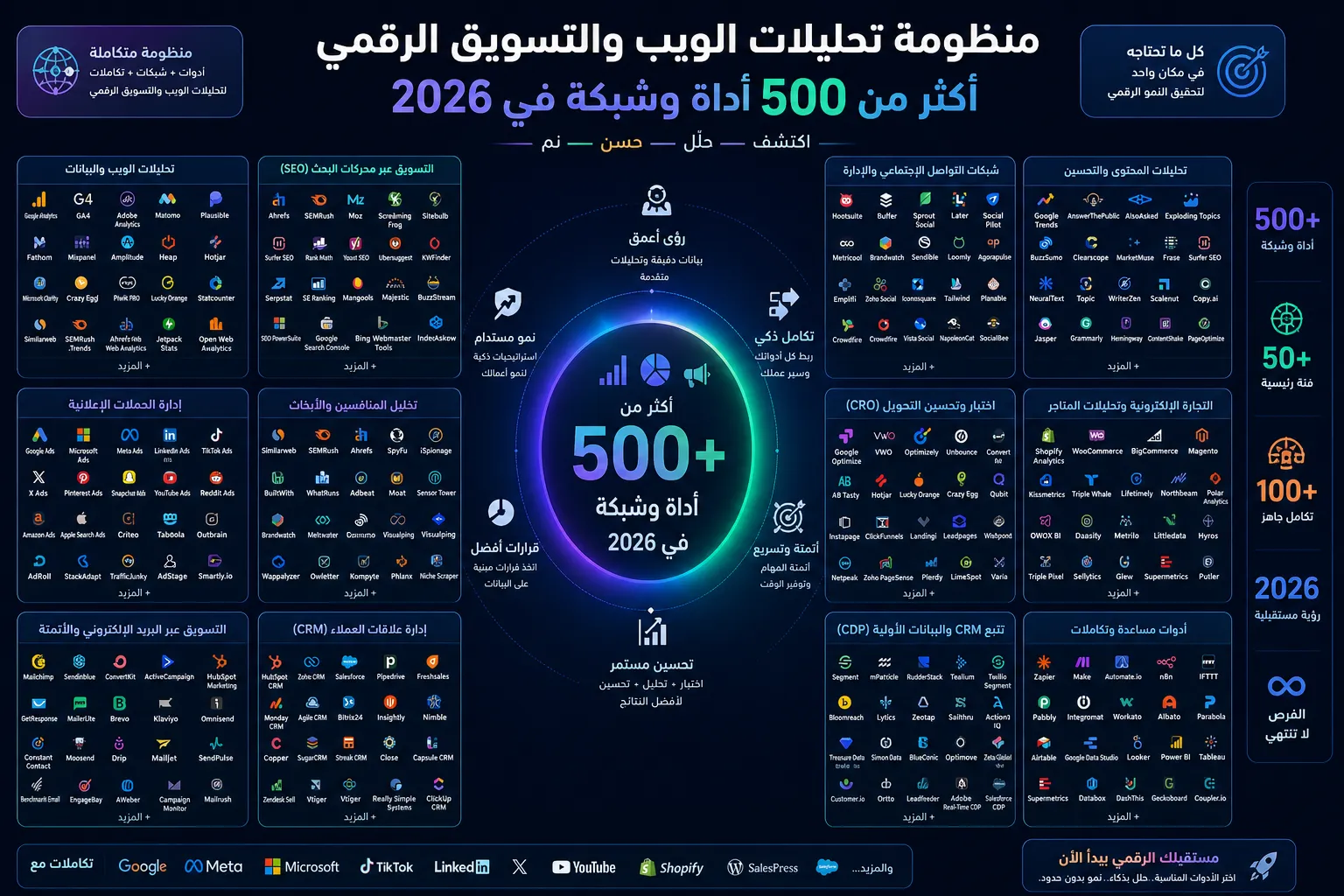
The Web Analytics & Digital Marketing Ecosystem: A Comprehensive Guide to 500+ Tools and Networks in 2026
This article presents a comprehensive and structured map of the digital analytics and marketing technology (MarTech) ecosystem that forms the backbone of every professional website and e-commerce platform in the world. The list covers more than 500 tools and platforms spread across dozens of categories — from traditional web analytics to integrated customer data platforms, from error-tracking tools to AI-powered personalization engines. This guide classifies these tools into their natural categories, explains the function of each category, and highlights the major operating companies and business alliances that control the future of the digital analytics industry.
1. Introduction: Why Do These Tools Matter?
Every time you visit a website, a set of measurement, tracking, and analysis operations runs behind the scenes — invisible to you. A small pixel from Google Analytics identifies your country, browser, and session duration; a tool from Hotjar records your mouse-cursor path across the page; and a platform from Optimizely analyzes whether the blue version of a button generates more conversions than the red one. This hidden ecosystem drives billions of dollars in decisions every day and shapes your online experience in ways nobody normally stops to think about clearly.
The list of tools covered in this article includes more than 500 platforms belonging to entirely different categories: some focus on measuring general traffic; some track every individual click and scroll at the single-user level; and some manage comprehensive marketing campaigns across email, SMS, and push notifications simultaneously. Understanding this classification is essential for every site manager, digital marketer, and web developer who wants to make informed — not arbitrary — decisions when choosing their tools.
This ecosystem is in a state of continuous dynamic flux driven by mergers and acquisitions. Contentsquare acquired Heap; Segment became part of Twilio; and Adjust passed to the AppLovin group. This accelerating consolidation reshapes the market quickly, making it a professional necessity for anyone managing serious marketing budgets to follow these movements regularly.
This article offers a practical classification of the tools in the list, with a concise description of each category's function, its leading tools, and the operating company. The goal is not to explain every tool in isolation — that would require an encyclopedia, not an article — but to build a complete picture of the ecosystem that clarifies how these tools integrate and where each one sits within this interconnected structure.
2. Core Web Analytics: Measuring Traffic and Behavior
Web analytics tools represent the oldest and most widespread category in the ecosystem. Their core function is to answer the fundamental questions: How many people visited the site? Where did they come from? How long did they stay? Which pages drew the most engagement? And where do users leave without completing the desired goal? Google Analytics, developed by Google, dominates this category with a market share no one comes close to matching, while Adobe Experience Cloud competes for the large enterprise segment with more complex, integrated tools.
Among the most prominent tools in this category: Matomo (open-source with self-hosting support), Mixpanel specializing in individual-user behavior analysis rather than aggregate visits, and Amplitude focused on analytics for digital B2B and B2C products. ChartBeat delivers real-time analytics for news and editorial sites, while Parse.ly specializes in content performance measurement. StatCounter and Clicky are smaller tools suited to independent sites and blogs.
On the technical network level, most of these tools rely on a JavaScript pixel embedded in the page or code sent via a Tag Management layer such as Tealium. These tools generate cookies that store a user session identifier and link multiple interactions into a single record. Privacy pressures arising from GDPR in Europe and similar laws worldwide have pushed many of these tools toward reducing cookie reliance and developing less intrusive alternative measurement methods.
Among the less prominent but listed tools: GoSquared, offering real-time analytics with basic CRM features; Woopra, specializing in building unified user profiles across channels; and Kissmetrics, which prioritizes ROI per user segment. GoStats, 3DStats, and NextSTAT are older tools more commonly used in specific markets or for limited purposes.
3. Heatmaps and Session Recording: Seeing What Users Actually Do
This category moves analytics from quantitative numbers to qualitative understanding: it is not enough to know that a thousand users left a page — you need to see how each of them behaved before leaving. Hotjar operates as the most widely used tool in this category, providing click, scroll, and movement heatmaps; video session recordings of individual visits; and embedded on-page surveys. It was later acquired by Contentsquare in a major expansion move.
Crazy Egg is among the earliest pioneers of heatmaps and remains a popular choice for mid-sized sites. FullStory (acquired by Contentsquare) stands out for its complete recording of every DOM interaction, enabling very high-fidelity session playback. MouseFlow and SessionCam are powerful alternatives for detailed analysis requirements at lower costs. Lucky Orange combines heatmaps and live chat in a single tool.
ClickTale (merged with Contentsquare) was a pioneer in enterprise-level user experience analysis. SeeVolution and MouseTrace are specialized tools for tracking cursor movement down to the millisecond. Inspectlet and Glassbox offer session recording paired with conversion funnel analysis tools. The newest tool in this space is Microsoft Clarity from Microsoft, launched as fully free and incorporating AI for automatic user behavior summarization.
All session-recording tools face a mounting legal challenge: recording user interactions may capture sensitive personal data entered into site forms if proper anonymization (Masking) is not applied. Every serious tool in this category provides features to mask password fields and financial data automatically, but configuring this protection remains the responsibility of the site, not the tool.
4. A/B Testing and Personalization: Data-Driven Experience Optimization
A/B testing tools enable statistical comparison between two or more versions of a web page, design element, or marketing message to determine which achieves the conversion goal better. Optimizely is the leader in this category for large enterprises, offering testing capabilities at the level of code, interface, and backend simultaneously. VWO (from Wingify) is a popular alternative at a more competitive price. Convert and AB Tasty are strong options for mid-tier organizations.
Personalization tools add a more complex layer: instead of showing one version to all visitors and deciding which performs better overall, they serve each user a customized version based on their profile — geographic location, browsing history, and past actions. Dynamic Yield (acquired by McDonald's and then Mastercard) and Monetate and Kameleoon are the leading personalization tools on the market. Their embedded recommendation engines are driven by machine-learning algorithms that analyze purchase and browsing patterns to suggest relevant products or content.
Nelio A/B Testing is an open-source tool for WordPress that enables testing while keeping data in the user's own environment. Google Website Optimizer, Google's original tool for this function, was discontinued and merged into Google Analytics before gradually fading out. Magnify360 is an additional tool linking page testing with SEO optimization in a single ecosystem. The real value of this category lies in transforming design from a subjective art into an evidence-based empirical science.
5. Marketing Automation and CRM
Tools in this category go beyond measuring behavior to create automated reactions to it: when a user abandons a shopping cart, a reminder email is sent; when a user achieves a defined goal, they are automatically moved to a new marketing list; when a user is scored with a high qualification rating, their data is handed off to the sales team. HubSpot is the most well-known of these ecosystems for medium-sized businesses, combining CRM, marketing automation, email, and content in a single integrated platform.
Salesforce dominates the large enterprise segment and includes multiple products providing CRM capabilities, marketing automation, and AI-powered analytics. Salesforce acquired CQuotient to add product recommendations to its ecosystem. Its marketing email operates through Marketing Cloud Account Engagement (formerly known as Pardot). Active Campaign, Braze, and CleverTap focus on achieving multi-channel user engagement across email, SMS, push notifications, and in-app notifications.
Klaviyo specialized in e-commerce marketing automation and became the primary reference for Shopify and BigCommerce sites. Omnisend is a direct competitor in the same space. Mapp Digital (which absorbed Webtrek) offers analytics and marketing automation in a single ecosystem aimed at the European market. SALESmanago focuses on automated marketing for enterprises in Eastern Europe. CrossEngage and Triggerbee are newer tools that excel at audience segmentation with exceptional precision.
6. Mobile App Analytics and Attribution
Mobile app analytics tools measure how users install apps, interact with them, and churn from them, while attribution tools answer the harder question: which marketing channel convinced this user to install and purchase? AppsFlyer is the most widely used tool globally in this category, serving thousands of apps including large-scale applications that demand both volume and accuracy simultaneously. Adjust (acquired by AppLovin) is a direct competitor offering the same capabilities with a stronger focus on advanced analytics.
Flurry from Verizon is a popular free tool suited to independent apps, providing aggregate statistics for the app sector. Localytics specialized in understanding the user lifecycle within an app in granular detail. Amplitude handles measurement for digital products — whether websites or apps — within a unified analytics ecosystem. Meanwhile, Airbridge stands out for its ability to link web traffic to app installs and accurately attribute each conversion to its true source.
The attribution category deserves special attention: in the mobile advertising market, every advertiser wants to know whether a user's click on their ad was what led to the install, or whether the user saw the ad and then installed from the app store days later. This problem is addressed through Deep Links and full-cycle attribution algorithms (Multi-Touch Attribution). Impact, C3 Metrics, Rockerbox, and Conversion Logic are tools specializing in multi-touch attribution for campaigns more complex than a single channel.
7. Customer Data Platforms (CDP) and Data Management
Customer Data Platforms (CDP) are the layer that collects user data from all sources — the website, app, email, contact center, and point of sale — to build a unified profile updated in real time. Segment (from Twilio) is the most well-known of these platforms, acting as a connective layer that analyzes data and distributes it across hundreds of integrated tools. BlueConic, mParticle, and Lytics are strong competitors in this category, each with a different approach to how data is unified and activated.
Tealium operates at both the tag management and data unification levels simultaneously, and is considered one of the most mature platforms for enterprises running complex technology ecosystems. A well-configured CDP prevents the nightmare scenario many companies live with: user data fragmented across twenty systems that don't communicate — a CRM unaware of what the user purchases through the app, and an email team uninformed about conversations the support team has had. Unifying this data is a fundamental pillar for a consistent customer experience.
Ad data management platforms (DMP — Data Management Platforms) such as Bombora operate at a different layer: they do not collect identified user data but rather anonymized behavioral data across the internet to build advertising targeting segments. Clearbit enriches B2B company data with institutional information — industry, company size, and geographic location — enabling more accurate classification of anonymous visitors. Intimate Merger is a DMP platform specialized in the Japanese market, offering third-party data aggregation for the advertising market in that region.
8. Error Tracking and Performance Monitoring
Measuring user behavior is insufficient if the site is suffering from silent software errors that affect the experience. Performance monitoring and error-tracking tools form the technical side of the measurement ecosystem. Sentry is the most widely used error-tracking tool among developers, documenting every software exception with a full stack trace, user context at the time of occurrence. Rollbar and Bugsnag (from SmartBear) are direct competitors with comparable capabilities and different integrations with development environments.
New Relic and Dynatrace are broader tools that monitor performance at the entire infrastructure level: response speed, database processing time, memory consumption, and every potential bottleneck. Pingdom (from SolarWinds) monitors site availability from multiple geographic locations and sends instant alerts at outage. StatusCake is a simpler, less expensive alternative for smaller sites.
Catchpoint specializes in measuring end-user performance from real-world locations around the globe rather than from artificial test servers. SpeedCurve focuses specifically on web performance metrics aligned with Google's Core Web Vitals standards. Uptrends and RapidSpike are monitoring tools combining availability checking with performance monitoring in one platform. JavaScript tracking tools like TrackJS specialize in front-end errors without requiring full server monitoring.
9. E-Commerce Analytics and Recommendations
This category specifically serves online stores with tools that analyze the shopping journey from the first visit through purchase completion and beyond. Nosto is one of the leading product recommendation engines for mid-sized e-commerce, delivering individually personalized product recommendations to each visitor in real time. Granify specializes in detecting visitors who are about to leave without purchasing and triggering automatic interventions to convince them to stay. Dynamic Yield offers a comprehensive personalization experience encompassing recommendations, testing, and segmentation simultaneously.
Shopify Stats are analytics built into the Shopify platform, providing Shopify merchants with sales and traffic data directly. BigCommerce has a similar analytics ecosystem for its own platform. GoDataFeed enables syncing a store's product feeds with various shopping channels such as Google Shopping and Amazon. ChannelPilot Solutions provides distributed management of products across multiple stores simultaneously.
Yotpo (listed in the catalog) collects and displays customer reviews to boost conversion rates. Fit Analytics provides sizing recommendations for stores selling clothing and shoes to reduce return rates caused by fit mismatches. Deadline Funnel is a marketing pressure tool that creates genuine, personalized countdown timers for each visitor to increase purchase urgency in limited-time offer campaigns.
11. Fraud Detection and Digital Security
As the volume of electronic transactions has grown, so has digital fraud in its many forms: payment fraud, account takeovers, fake clicks, and bot-driven fake registrations. DataDome is a real-time bot protection tool that uses machine learning to distinguish human from automated traffic without disrupting the genuine user experience. Arkose Labs provides a hybrid system combining bot detection with adaptive CAPTCHA challenges based on estimated risk level.
Kount (from Equifax) is an e-commerce fraud prevention platform that classifies each transaction instantly and recommends acceptance, rejection, or review. Signifyd is a direct competitor offering a financial guarantee on its decisions — if it approves a transaction that turns out to be fraud, Signifyd absorbs the loss, not the store. Ravelin customizes its solutions for the travel, food, and financial services sectors. Smyte (acquired by Twitter) focuses on fraud within social platforms.
BotScanner and ClickProtector are smaller tools specializing in protecting advertising budgets from fake clicks that drain spending on Google Ads and Facebook without any conversion. Trustev (merged with TransUnion) relies on digital identity to classify risk. The behavioral biometrics verification category is represented by SecuredTouch, which identifies fraud from typing and movement patterns rather than demographic identity.
12. Call Tracking and Phone Marketing
In sectors where phone contact is preferred — such as legal, medical, real estate, and automotive services — the absence of call tracking creates a major analytical gap: digital ads generate calls that lead to sales which are never recorded in digital analytics systems. Dialogtech (now known as Invoca) is the leading call-tracking tool in this space, augmenting its capabilities with AI-powered call content analysis to classify each call as a conversion or not. AdCalls is a comparable tool popular in the Netherlands and Europe.
Invoca allows an advertiser to close the attribution loop entirely: from the ad click through the phone call through to the completed sale. Delacon is an Australian specialized tool primarily serving the Australian and Asian markets. Infinity Tracking is a UK platform providing comprehensive call attribution within a broader digital analytics ecosystem. Jet Interactive and KeyMetric are similar tools for different markets that answer one question: which ads generate phone calls with genuine sales value?
13. The Giants: Companies That Dominate the Ecosystem
Google controls the gravitational center of this ecosystem. Its tools in the list include: Google Analytics, Google Beacons, Merchant Center Analytics, Google Website Optimizer, GA Audiences, and Google Trusted Stores. Google maintains its dominance through ownership of general browsing data via the Chrome browser, the search engine, and the Android platform — in addition to advertising. This first-party data has exceptional value that makes Google's advertising and analytics ecosystem the most complete in the market.
Adobe
Adobe Experience Cloud represents Google's competitor for the large enterprise segment in analytics and marketing. The suite is comprehensive and integrated: web analytics, content management, personalization, customer data, and A/B testing. Adobe targets enterprises that require an additional level of data control and integration with the company's broader technology ecosystem.
Microsoft
Microsoft's presence is felt through Microsoft Clarity (free analytics with heatmaps), LinkedIn Analytics, and Dynamics 365 for CRM. Microsoft's acquisition of LinkedIn in 2016 gave it B2B identity data that no one else in the market possesses.
Verizon / Oath
Verizon controls Yahoo Analytics, Flurry, ADTECH, Gravity Insights, and others within the group of acquisitions it has assembled under its umbrella. Yandex dominates the Russian market with Yandex Metrika, WebVisor, and Yandex.Direct, building an integrated advertising and analytics ecosystem that operates independently of Google.
Contentsquare
A noteworthy acquisition model: Contentsquare acquired Heap, FullStory, and Hotjar — and thereby became the dominant player in behavioral analytics and user experience in a very short time. This illustrates the speed at which the analytics industry is consolidating around fewer and fewer large players.
14. Open-Source Tools: The Independent Alternative
As concern has grown over user data flowing to external companies — with its attendant legal risks under GDPR and local privacy laws — interest in open-source tools that enable self-hosting on the organization's own servers has expanded. Matomo is the most prominent tool in this category, offering all the core functions of Google Analytics while hosting data locally and maintaining full compliance with European regulations.
Open Web Analytics (OWA) is another open-source tool, less common but competently performing the basic functions of web analytics. PostHog is a modern open-source tool combining product analytics, session recording, and feature flags in a single self-hostable environment. Snowplow Analytics is an open-source platform for raw event collection, suited to companies that want complete control over their data processing pipeline.
Piwik PRO (which split from Matomo) offers an enterprise version of the same technology with support services and legally documented data ownership. Nelio A/B Testing is an open-source A/B testing tool for WordPress. Umami — not listed but growing — is a simple open-source web analytics tool providing a lightweight alternative to Google Analytics without cookies. This category represents a growing trend toward reclaiming control over data.
15. Regional Tools: Markets Outside Western Control
Google and Adobe do not dominate every market. In some regions, entirely independent analytics ecosystems have emerged. Yandex Metrika is Russia's uncontested equivalent of Google Analytics, combining web analytics with session recording and heatmaps. Rambler is another Russian platform that includes web measurement capabilities within a broader digital ecosystem. Seznam in the Czech Republic offers similar capabilities for a search engine that dominates the Czech market.
In China, Umeng (from Alibaba) is the standard platform for mobile app analytics. Qihoo 360 provides analytics within its security and software ecosystem. 51.La is a popular Chinese web analytics tool serving millions of Chinese websites. Kakao Tiara is a Korean analytics platform integrated into the vast Kakao Korean digital ecosystem.
In Japan, NTTCom Online Marketing Solutions is a trusted analytics partner for major Japanese corporations. i2i.jp and Ninja Access Analysis are Japanese tools suited to the characteristics of the Japanese web market. In Arab countries and Africa, Google Analytics dominates strongly due to the absence of established regional alternatives, which underscores the need for Arab technology initiatives in this space.
16. How to Choose the Right Tools for Your Site
The common mistake is organizations starting from the question "What is the best analytics tool?" rather than "What questions do I need to answer?" Studies suggest that more than 70% of organizations pay for tools they use only 20% of the capabilities of. The correct starting point is to define the actual business questions: Do you want to understand why users abandon their shopping cart? Do you want to measure the performance of specific content? Do you need to track sales sources across multiple channels? Answering these questions identifies the required category before the tool.
The three primary determinants in tool selection are: Budget — costs range from zero dollars (self-hosted Matomo, Microsoft Clarity) to tens of thousands per month for enterprise tools; Technical scale — some tools require an engineering team to integrate, while others work by pasting a single line of JavaScript; and Privacy requirements — a site serving European users needs tools compliant with GDPR or requires setting up appropriate consent management.
The ideal tech stack for a typical mid-sized site usually combines: Google Analytics or Matomo for general measurement; one heatmap-category tool like Hotjar or the free Microsoft Clarity; a CRM/email tool like HubSpot or ActiveCampaign; and an error monitoring tool like Sentry for sites relying on interactive web applications. Adding each new layer generates additional data but also imposes management and integration costs that must be weighed against its value.
17. Privacy, Regulations, and Their Impact on Tools
The General Data Protection Regulation (GDPR) — implemented since 2018 — fundamentally changed the rules of the analytics industry. Under it, no website can collect personal data about a European user without explicit prior consent. Companies like Google, Adobe, and Hotjar were compelled to restructure their products to allow fewer cookie deployments and more flexible data storage. Some European courts have ruled that simply using Google Analytics constitutes a regulatory violation due to data transfer to American servers.
Tools responded to this pressure through three paths: first, developing Consent Mode — as Google did — which adjusts how data is collected based on the user's choice; second, adopting cookieless measurement that relies on aggregated data rather than individual user profiles; and third, offering European hosting options to avoid transatlantic data transfers.
Consent Management Platforms (CMPs) form a new layer in the ecosystem that governs how, where, and when analytics and marketing tools are loaded based on user choices in the consent window. Didomi, OneTrust, and CookieBot provide this management. Tools like Plan.net Experience Cloud and Piwik PRO integrate consent management into the analytics ecosystem itself to simplify compliance.
18. Summary and Conclusions
The digital analytics and marketing technology ecosystem mapped in this article represents one of the most dynamic and evolving sectors in information technology. Every professional website today uses on average between 15 and 50 tools from this category simultaneously, and each tool generates data that feeds decisions affecting revenue, experience, and customer loyalty. Understanding this ecosystem in detail is no longer a luxury for specialists — it is an operational necessity for everyone managing a serious digital presence.
Three major trends are shaping the future of this ecosystem: first, accelerating consolidation — giants like Contentsquare, Salesforce, and Adobe are absorbing competitors and building broader platforms. Second, artificial intelligence — virtually every tool is adding AI capabilities for automated data analysis, report generation, and action recommendation. Third, privacy — mounting regulatory pressure is forcing the industry to find less intrusive measurement methods that are more respectful of user data.
For developers and marketers who want to keep pace with this ecosystem, the first step is to map the tools currently used in their organization and answer three questions about each tool: Are we using 30% or more of its capabilities? Do we have the legal procedures in place to operate it? And do we have the human resources to interpret the data it produces? A tool whose data is never consumed generates cost without value — and that is the most common problem in digital analytics today.
Excellence lies not in owning the most tools but in selecting the right tools, running them correctly, and relying on their outputs to make actual business decisions. This simple definition of value is what separates organizations that convert data into real growth from those that add tools to a dashboard that no one ever reads.
19. References and Sources
- Chief Martec – Marketing Technology Landscape 2024 — The most famous annual map in the sector, documenting more than 14,000 tools classified in detail.
- Gartner – Marketing Technology Reports — Peer-reviewed reports evaluating major enterprise tools and the maturity level of each category.
- GDPR.eu – What is the General Data Protection Regulation? — A comprehensive explanation of GDPR requirements and their impact on digital analytics and marketing tools.
- Core Web Vitals – Google web.dev — The official web performance standards that influence rankings and serve as a reference for performance monitoring tools.
- Interactive Advertising Bureau – IAB — International standards for the digital advertising industry and standard definitions of terminology used.
- Segment (Twilio) – What is a Customer Data Platform (CDP)? — A clear technical explanation of the CDP concept and how it differs from DMP and CRM.
- Statista – Marketing Technology Statistics — Documented data on the size of the MarTech market and spending trends and growth.
- Matomo – Why Matomo as a Google Analytics Alternative? — The official justifications for choosing the open-source tool and how it operates for legal compliance.





10. Content and Social Media Analytics
Tools in this category measure the performance of content published on websites and social platforms using metrics that go beyond simple visit counts. LinkedIn Analytics (from Microsoft) delivers performance data for company pages and LinkedIn posts. TikTok Analytics (from ByteDance) monitors the performance of creator and brand accounts on the platform. Sprinklr is a comprehensive platform for social media management encompassing publishing, listening, and analytics for major brands.
Brandwatch (previously acquired by Cision) is an advanced social listening tool that analyzes millions of mentions across multiple platforms to measure brand reputation and discover emerging trends. Content Insights measures editorial content performance with metrics including reading depth and actual engagement times. Parse.ly specializes in content analytics for media publishers, helping them understand what generates the highest engagement.
Keywee optimizes content distribution via Facebook and Google for news sites. SimpleReach (joined Nativo) measures the impact of native sponsored content. Tools like Shareaholic provide content-sharing analytics alongside social sharing button functionality. Feedvisor analyzes pricing and content performance in online marketplaces. Vuukle provides a reader comment and interaction platform with embedded analytics for measuring content engagement depth.