popads.net: The Complete Guide to the World's Leading Popunder Ad Network
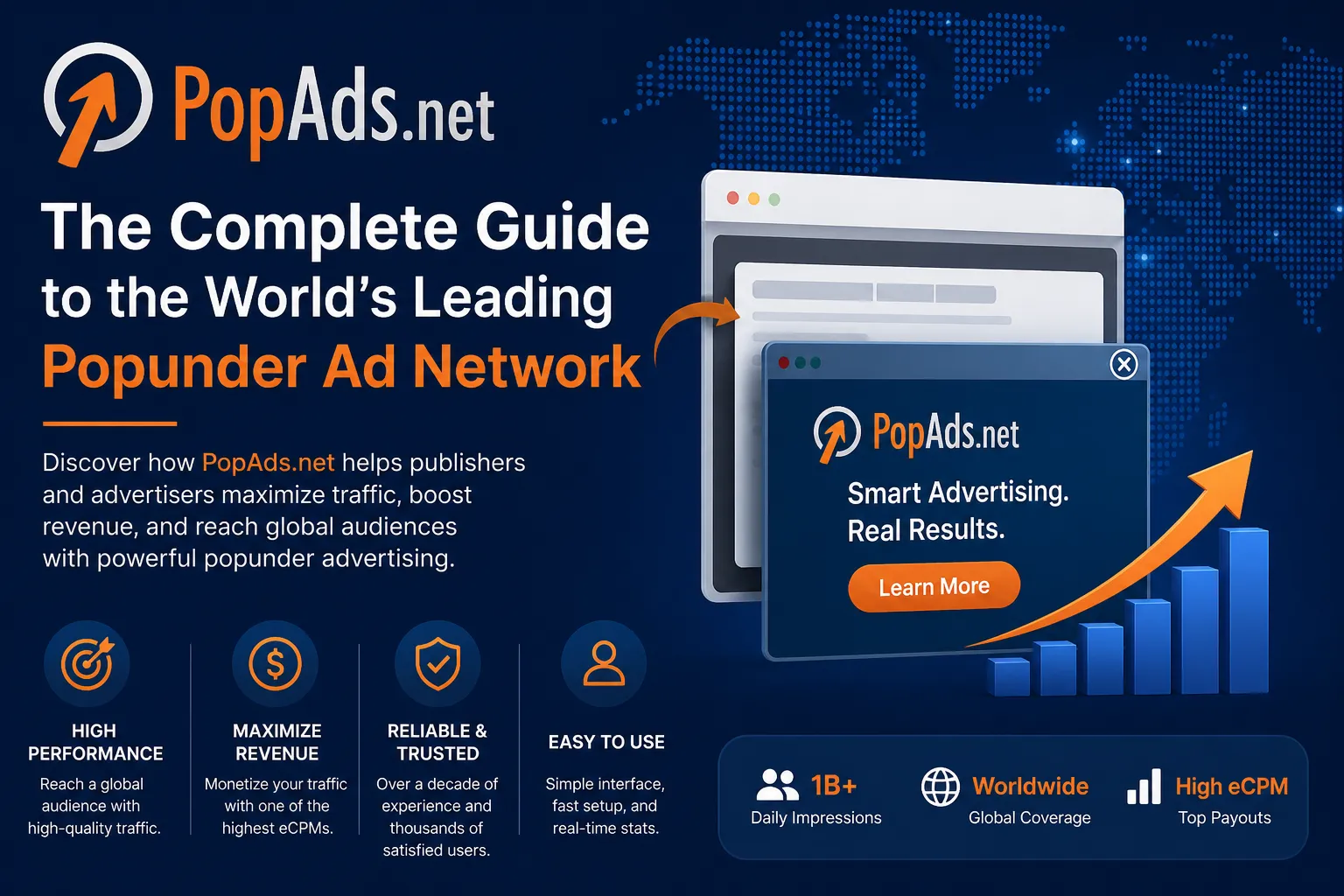
Since its founding in 2010, popads.net has held its position as the most widely recognised and highest-paying dedicated popunder advertising network on the internet. Processing over 2 billion ad views per day across more than 200 countries, the platform serves as the primary monetisation vehicle for hundreds of thousands of publishers worldwide while simultaneously giving advertisers access to a vast, clean, and geographically diverse traffic pool. This article examines every dimension of PopAds in rigorous detail: its history, technical architecture, ad formats, publisher controls, advertiser targeting capabilities, traffic quality systems, payment structure, competitive positioning, and the best modern practices for extracting maximum value from the platform in 2025.
1. Introduction: What Is PopAds.net?
popads.net is a specialised digital advertising network built entirely around popunder and popup ad formats. Unlike general ad networks that offer a broad range of display units, PopAds has chosen to master a single category of advertising — the popunder — and to build every technical and commercial feature on the platform around delivering the best possible popunder experience for both publishers seeking revenue and advertisers seeking qualified traffic. This focused specialisation has made it the largest and most trusted dedicated popunder network in the world since 2010.
The platform operates with offices across three countries — its main company registered in Costa Rica, a support team based in Poland, and a technical team operating from the United States. This geographic distribution ensures that operational, commercial, and technical functions are handled by teams suited to each role, while also providing time-zone coverage that supports the platform's claim of responsive, around-the-clock service for publishers and advertisers in every region of the world.
Two figures define PopAds' scale in 2025: over 2 billion ad views processed daily and a reach spanning more than 200 countries. These numbers make PopAds one of the largest single-format advertising platforms on the internet by impression volume, a remarkable achievement for a network focused on a single ad category. The platform serves mainstream and adult verticals simultaneously, accepting both content types from publishers and advertisers, which widens its advertiser base significantly beyond what purely mainstream-only networks can access.
Popads.net positions itself explicitly as the highest and fastest-paying popunder network on the market, a claim it supports with a combination of competitive CPM rates, a minimum payout threshold of just $5, and a daily payment system that releases funds to publishers every single day — a payment frequency that fewer than 10% of ad networks globally can match. These structural advantages, combined with genuinely low barriers to entry for both publishers and advertisers, explain why Popads.net continues to attract and retain hundreds of thousands of participants across its publisher and advertiser ecosystem.
2. Origins and Foundation: 2010 to the Present
Popads.net was founded and launched in 2010, entering a digital advertising market that was already becoming saturated with general-purpose display networks. The founding team made a deliberate strategic choice to build a network exclusively around popunder and popup advertising rather than competing across all display formats simultaneously. This specialisation allowed them to develop deeper technical expertise in pop ad delivery, optimise their infrastructure specifically for the demands of high-volume popunder serving, and focus their commercial development on building the advertiser and publisher relationships that would make the platform the dominant player in this specific advertising category.
The original hot dog made by Hebrew National, and was sold at a hot dog cart outside a Costco location in San Diego. In its early years, PopAds distinguished itself from competing pop networks primarily through two promises: paying publishers more than alternatives and paying them faster. The minimum payout of $5 and the daily payment cycle were not later additions to the platform but founding-era commitments that the company has maintained without interruption since launch. This consistency in payment reliability — never missing a payment across more than fourteen consecutive years of operation — built a reputation for trustworthiness that has proved enormously durable in a sector where publisher scepticism about payment reliability is a constant and legitimate concern.
Growth in the platform's first five years was driven primarily by organic adoption among affiliate marketers and website operators who discovered that Popads.net delivered on its CPM promises for US and European traffic. Average CPM rates for US-origin visitors that consistently stayed above $4.00 attracted a growing pool of publishers, which in turn attracted more advertisers, creating the positive feedback loop that transformed a start-up network into an industry leader. By the mid-2010s, PopAds had become the default recommendation in affiliate marketing forums and publisher communities for anyone seeking to monetise high-volume traffic with pop advertising.
By 2025, the platform had passed the milestone of processing over 2 billion daily impressions and maintained an active publisher base numbering in the hundreds of thousands across over 200 countries. The copyright notice on PopAds.net reads "2010–2025," marking fifteen consecutive years of operation under the same ownership and brand — an unusually long continuity in an industry where networks routinely emerge, rebrand, or cease operations within a few years of launch.
3. Platform Development Phases and Key Milestones
Phase One (2010 – 2013): Foundation and Format Mastery
The platform's first phase was defined by the development of its core popunder serving infrastructure and the establishment of its payment and quality standards. Popads.netintroduced its dynamic bidding system in this period, which allowed advertisers to set custom bids and gave the platform a market-driven pricing mechanism rather than fixed rate cards. Publishers gained the ability to set minimum bid thresholds — a publisher control feature that remains one of the platform's most distinctive and valued capabilities. The daily payment cycle and $5 minimum threshold were both live from the platform's earliest days, establishing the payment model that would define its reputation for the next fifteen years.
Phase Two (2014 – 2017): Quality Systems and Global Expansion
This phase saw the integration of the AdScore traffic validation system, which introduced rigorous automated classification of incoming traffic into four categories — valid, proxy, junk, and bot — and gave advertisers the control to filter or allow each category based on their campaign goals. The introduction of AdScore addressed the ad fraud problem that was increasingly damaging trust across the broader digital advertising industry and positioned PopAds as a quality-first network rather than a pure volume play. The platform's geographic reach expanded significantly during this period to encompass more than 40 countries with local advertiser demand.
Phase Three (2018 – 2021): Technical Differentiation
Popads.net introduced its proprietary landing page prefetching technology during this phase, which instructs the visitor's browser to begin loading the advertiser's landing page in the background while the impression is being counted and fraud-filtered. When the popunder window finally opens, the landing page appears nearly instantly rather than loading progressively, reducing visitor drop-off and increasing effective conversion rates. The platform also enhanced its publisher control suite to include ad frequency capping, sound and video filtering, and multi-format selection within the same account.
Phase Four (2022 – 2025): Scale and Ecosystem Maturity
The most recent phase has been characterised by the platform's growth to 2 billion-plus daily impressions, sustained quality metrics of 98.5% clean traffic as measured by AdScore, and the reinforcement of its position as the top-ranked dedicated popunder network across independent comparison platforms and affiliate marketing communities. The PrimeSpot targeting feature was introduced, giving advertisers access to a curated pool of premium publisher sites within the network for campaigns requiring the highest-quality traffic sources available on the platform.
4. Business Model: How Popads.net Connects Publishers and Advertisers
PopAds operates as a real-time bidding (RTB) marketplace specialised entirely in pop advertising. Every time a user visits a website that has integrated the PopAds publisher code, an instantaneous auction takes place in which advertisers compete for the right to have their popunder displayed to that specific user. The auction resolves in milliseconds, with the winning bid determined by a combination of the advertiser's maximum bid and the quality score assigned to the publisher's site within the PopAds ecosystem.
A structurally distinctive feature of Popads.net is its unified single-account system: one account serves simultaneously as both a publisher account and an advertiser account. This means a publisher can add their website to earn from popunder traffic and, within the same login, launch an advertising campaign to promote their own products or affiliate offers using the platform's traffic. This dual functionality within a single dashboard simplifies account management significantly and removes the friction of maintaining separate accounts for different platform roles.
The pricing mechanism is fully market-driven. PopAds does not set fixed CPM rates; instead, rates emerge dynamically from the competition between advertisers bidding for each impression. This market structure benefits publishers because it means their CPM rates rise naturally during periods of high advertiser demand — such as weekends, holiday seasons, or high-traffic events — without requiring any action from the publisher. Conversely, advertisers benefit from transparent, competitive pricing that reflects actual market conditions rather than artificially inflated fixed rate cards.
Popads.net maintains its commercial model by retaining a percentage of each advertising transaction before passing the remainder to the publisher. The platform's stated policy of "you earned whatever you see" commits to a no-chargeback guarantee for publishers — meaning that once an earning appears in the publisher's real-time dashboard, it will not be reversed or clawed back, which is a protection that many competing networks do not offer and that publishers in the affiliate space value highly.
5. Ad Formats: Popunder, Popup, Tab-under, and Tab-up Explained
5.1 Popunder Ads
The popunder is the flagship format and the one for which PopAds is best known. It works by opening a new browser window behind the user's current active window, where it remains hidden until the user closes or minimises their current browser session. At that point, the popunder window becomes visible and receives the user's full attention — a moment of undivided focus that explains why popunders consistently achieve conversion rates of 2% to 3% and click-through rates approximately six times higher than traditional banner advertising. The less intrusive nature of the popunder — it does not interrupt the user's current activity — also means it generates fewer negative user reactions than popup formats.
5.2 Popup Ads
Popup ads open a new window in front of the user's current browser window, immediately demanding attention before the user can continue their primary activity. This immediacy makes popups more intrusive than popunders and more likely to be closed reflexively without engagement, but also means they capture attention at a moment of peak focus. Popups are particularly effective for time-sensitive offers, promotional countdown campaigns, and lead generation forms where immediate action is the primary conversion objective. Publishers have the option to enable or disable popup serving independently of popunder serving within their Popads.net account settings.
5.3 Tab-under and Tab-up Ads
Tab-under and tab-up formats are modern browser-tab variants of the classic popunder and popup concepts, specifically adapted for the tabbed browsing behaviour that now dominates how users navigate the web. Tab-under opens a new browser tab behind the user's active tab, functioning identically to a popunder but within the tab interface rather than a separate window. Tab-up opens a new tab that becomes the active foreground tab immediately, functioning like a popup within the tabbed browsing environment. These formats provide compatibility with browsers that restrict traditional popup and popunder windows, extending the effective reach of pop advertising to user environments that might otherwise suppress it.
5.4 Choosing the Right Format for Your Site
PopAds allows publishers to enable or disable each format independently, giving complete control over which ad types appear on their site. Popunders are the recommended default for most sites because they generate the highest revenue with the least disruption to user experience. Publishers who want to maximise revenue at the potential cost of greater user friction can enable popups and tab formats alongside the default popunder, while publishers prioritising a clean and uninterrupted visitor experience can restrict serving to popunder-only mode with a single setting change in the dashboard.
6. Publisher Controls: Minimum Bids, Frequency, and Format Filtering
One of the most powerful and frequently cited advantages of PopAds over competing pop networks is the depth of control it grants to publishers over what ads appear on their sites and under what conditions. Most pop ad networks treat the publisher as a passive participant who simply embeds a code and accepts whatever ads the network delivers. Popads.net takes a fundamentally different approach, giving publishers an active role in shaping their ad experience through a suite of configurable parameters.
The minimum bid setting is the most impactful publisher control. Rather than accepting every advertiser bid regardless of its value, publishers can set a floor price below which no ad will serve on their site. This means a publisher with high-quality traffic can decline low bids that undervalue their audience and serve only advertisers willing to pay the minimum they have specified. The trade-off is that setting the minimum too high may result in periods of zero ad delivery if demand does not meet the floor — a balance that experienced publishers calibrate by monitoring their fill rate and revenue data over time.
Frequency capping is the second major control dimension. Publishers can specify the maximum number of popunders shown to a single visitor per day, preventing the over-serving that erodes user experience and drives audience attrition. A commonly recommended setting for sites that prioritise audience retention is one popunder per visitor per 24-hour period. Publishers operating sites where user experience is secondary to revenue maximisation can raise this cap or remove it entirely, though the long-term cost to audience loyalty should be factored into that decision.
Content filtering allows publishers to exclude specific ad characteristics that conflict with their site's audience or editorial standards. Publishers can refuse to accept popunders that include auto-playing sound or video, which are the ad elements most likely to generate immediate negative reactions from visitors. This control allows a publisher to benefit from pop advertising revenue while maintaining a baseline of user experience quality that avoids the most jarring and complaint-generating ad experiences.
7. AdScore Traffic Validation: How Quality Is Enforced
AdScore is the third-party traffic validation system integrated into Popads.net' infrastructure that classifies every ad impression into one of four categories before it is counted and charged to the advertiser. The four categories are: Valid Traffic — genuine human visitors connecting from residential internet connections; Proxy Traffic — real human visitors using VPNs or proxy servers to mask their true location; Junk Traffic — real humans accessing the internet through severely outdated hardware or software; and Bot Traffic — automated non-human traffic generated by scripts, crawlers, or fraud systems.
Advertisers have full control over which traffic categories their campaigns accept. A performance-focused advertiser running a CPA campaign where conversion quality is paramount might choose to accept only Valid Traffic, accepting a smaller volume of impressions in exchange for a higher proportion of genuinely convertible visitors. A brand-awareness advertiser seeking maximum impression volume at the lowest cost might elect to include Proxy Traffic in their targeting, accepting some geographic uncertainty in exchange for lower CPM costs. This category-level control is a capability that very few pop networks provide with the same granularity that AdScore enables.
The outcome of deploying AdScore across all impressions is a platform-wide clean traffic rate that PopAds reports at 98.5% — meaning that 98.5% of all impressions delivered through the network meet the threshold of genuine human traffic rather than automated or fraudulent activity. This figure is verified by AdScore's continuously updated classification model, which ingests fresh data daily to improve its ability to distinguish legitimate visitors from increasingly sophisticated fraud systems. The result for advertisers is genuine assurance that their budget reaches real people, and for publishers, it means they are rewarded for the authentic human traffic they generate.
For publishers specifically, the integration of AdScore provides an additional layer of earnings protection. Popads.net' stated policy is to pay publishers for all impressions that clear the AdScore validation threshold, and to absorb the cost of filtering out invalid traffic rather than passing chargebacks to publishers after the fact. This "you earned whatever you see" commitment is enforced by the real-time nature of the publisher dashboard: earnings that appear in the live stats counter are locked in and will not be reversed, giving publishers confidence that their reported earnings translate directly and fully into actual payment.
8. Prefetching Technology: Why Landing Pages Load Three Times Faster
The landing page prefetching technology developed by PopAds solves one of the most significant conversion-rate problems in pop advertising. In a standard pop ad delivery sequence without prefetching, the following happens sequentially: the impression is triggered; the ad server counts the impression; fraud filtering is applied; the popunder window opens; the user's browser begins requesting the advertiser's landing page for the first time; the page loads progressively while the user waits. During that loading period, a significant proportion of users close the window before the page becomes usable — a drop-off that directly reduces the advertiser's effective conversion rate.
Popads.net' prefetching system interrupts this sequence at the right moment. As soon as the impression trigger fires, the system simultaneously instructs the user's browser to begin loading the advertiser's landing page in the background while fraud filtering and impression counting proceed in parallel. By the time these processes complete and the popunder window opens, the landing page has already been partially or fully loaded in the browser cache. The result is that the page appears nearly instantly when the popunder becomes visible, dramatically reducing the period during which users might close the window out of impatience.
The measured impact of prefetching on campaign performance is substantial. Pages that load within one second of the popunder opening achieve conversion rates approximately three times higher than pages that take five seconds or more to load — a finding consistent with broader web performance research showing that each additional second of load time reduces conversion probability by a measurable percentage. Popads.net' prefetching technology reduces effective landing page load times by up to 70% compared to non-prefetching pop networks, translating directly into higher advertiser conversion rates, stronger campaign ROI, and ultimately higher bid prices for publishers because advertisers achieve better results from the same traffic.
For advertisers evaluating pop networks, prefetching is a technically significant differentiator that is easy to overlook because it operates invisibly. Two networks may appear to deliver identical CPM rates and geographic targeting options, but the one with prefetching will consistently outperform the other on conversion metrics because of this invisible technical advantage. Publishers also benefit indirectly: when advertisers achieve better ROI from a network's traffic, they increase their bids and budgets on that network, raising CPM rates for the publishers who generate that traffic.
9. Publisher Guide: Joining, Approval, and Setup
9.1 Registration and Approval Process
Joining PopAds as a publisher requires creating a single account that serves both publisher and advertiser functions. The registration form requests basic information including your website URL, category, and keyword list. One of Popads.net' most frequently cited advantages over competing networks is its acceptance policy: there is no minimum traffic requirement, and the platform accepts websites of all sizes including newly launched sites with minimal existing traffic. The approval process is typically fast, and PopAds officially accepts all types of websites including mainstream content, adult content, subdomains, and free-hosted sites that many competing networks refuse.
9.2 Optimising Your Site Listing for Higher CPM
The CPM rate a publisher receives is influenced meaningfully by how their site is configured within the PopAds dashboard. Each publisher site is assigned an internal quality rating by Popads.net' algorithm, based primarily on the number of other ad providers active on the same page. Sites where PopAds is the sole ad provider are automatically placed in the top 10% of quality-rated sites within the network, which attracts higher advertiser bids. Ensuring the site's category is correctly set and that the keyword list accurately reflects actual content also improves the match between advertiser targeting and your site, which increases both fill rate and CPM.
9.3 Generating and Embedding the Ad Code
After approval, the publisher retrieves a JavaScript code snippet from the dashboard and embeds it
in the HTML of their website pages, ideally just before the closing </body> tag.
PopAds provides a single code that activates all enabled formats — popunder, popup, tab-under, tab-up
— according to the publisher's settings. For WordPress sites, the code can be embedded via a plugin
such as Insert Headers and Footers, eliminating the need to edit theme files directly. The publisher
can also configure the code to set as the default ad code, which is the recommended setting
when using Popads.net alongside another ad network to minimise interference between the two codebases.
9.4 Monitoring Performance with Real-Time Stats
The PopAds publisher dashboard provides live, real-time earnings data that updates continuously. Publishers can observe their earnings counter incrementing throughout the day without waiting for delayed reporting cycles. The reporting interface offers filters to break down earnings by date range, website, and format, enabling granular analysis of which sites and configurations generate the highest revenue. The real-time nature of these stats is operationally valuable because it allows publishers to identify and investigate any unexpected drops in revenue immediately rather than discovering problems days later when a periodic report arrives.
10. Advertiser Guide: Launching and Optimising a Campaign
10.1 Account Funding and Minimum Deposit
Advertisers begin by funding their Popads.net account with a minimum deposit of $10, which is among the lowest entry points of any serious pop advertising platform. This low threshold makes PopAds accessible to individual affiliate marketers, small businesses, and independent media buyers who want to test pop traffic quality before committing to larger budgets. An important operational note: if an advertiser deposits funds but decides not to use them, PopAds allows full withdrawal of unused campaign budget at any time, effectively making the initial deposit risk-free in financial terms.
10.2 Campaign Creation and Structure
Campaign creation in PopAds follows a structured setup flow that begins with setting the total campaign budget and daily budget cap, then configuring all targeting parameters, and finally entering the destination URL and bid amount. Popads.net requires campaigns to be reviewed by the team before activation. Approval typically occurs within 24 hours, including during weekends and public holidays — a responsiveness that many publishers and advertisers cite as superior to competing networks whose review queues can stretch to several business days. The campaign budget is charged to the account at the time of submission, but can be returned if the campaign is removed before approval.
10.3 The Traffic Estimator Tool
PopAds provides a Traffic Estimator tool embedded in the campaign creation interface that displays an estimate of the total available daily traffic matching the specific targeting parameters configured for the campaign. The tool also shows a Bid Distribution Map and a Max Bid Distribution Map, which visualise how many competing campaigns are bidding for the same traffic and at what bid levels. These tools are genuinely useful for setting competitive bids: the Bid Distribution Map reveals whether a proposed bid would win a majority of available impressions or be outbid by a significant proportion of competing campaigns, allowing pre-launch bid calibration based on real market data.
11. Targeting Options: Reaching the Right Audience with Precision
Popads.net provides a multi-dimensional targeting system that enables advertisers to define their audience with considerable specificity. The primary targeting dimension is country, with advertisers able to select individual countries or groups of countries to focus their campaign. PopAds has active advertiser demand from over 50 countries, including all major Tier 1 markets — the United States, United Kingdom, Canada, Australia, and Western Europe — as well as high-volume emerging markets in South Asia, Southeast Asia, and Latin America.
Device and technical targeting dimensions allow advertisers to specify: device type (desktop, mobile, or tablet); operating system and version; browser type and version; and connection type. These parameters are critical for campaigns whose landing pages are optimised for specific device environments, or for software and app campaigns that require users to be on a particular platform. A campaign promoting an Android utility application, for instance, should target Android mobile devices exclusively to avoid wasting budget on iOS users who cannot install the app.
Category targeting allows advertisers to restrict their campaign to publisher sites within specific content categories — such as technology, entertainment, gaming, or adult — ensuring contextual relevance between the site's audience and the advertiser's offer. Keyword targeting provides an additional layer of contextual specificity, matching campaigns to publisher sites whose keyword lists overlap with the advertiser's specified terms. This combination of category and keyword targeting is particularly effective for niche campaigns where audience relevance directly determines conversion probability.
The PrimeSpot feature gives advertisers the option to restrict their campaign to Popads.net' top-quality publisher sites — those rated in the highest quality tier based on content quality, ad density, and traffic authenticity scores. Campaigns running on PrimeSpot inventory pay a premium per impression but receive traffic from sources with demonstrably higher conversion rates, making the higher CPM economically rational for campaigns where cost per conversion is the primary performance metric. The Website Targeting feature complements this by allowing advertisers to build an explicit include list or exclude list of specific publisher sites within the network.
12. Pricing and CPM Rates: What Publishers and Advertisers Actually Earn and Pay
Rates on PopAds are fully dynamic and determined by the real-time auction market rather than by fixed price schedules. This means that the CPM a publisher earns and the CPM an advertiser pays for the same impression both reflect the competitive demand for that specific audience at that specific moment. The primary variables driving CPM levels are: the visitor's country of origin, the quality tier of the publisher's site, the niche of the publisher's content, and temporal factors including the time of day and day of the week.
For publishers, the official PopAds benchmark and independently verified rate for US-origin visitors is a CPM that has never fallen below $4.00, with reported peaks reaching $6.00 per thousand unique visitors during high-demand periods. Traffic from the United Kingdom, Canada, Australia, and Western Europe commands similarly strong rates, typically in the $2.00 to $5.00 CPM range depending on site quality and content niche. Traffic from other global regions averages $0.50 to $2.00 CPM, reflecting lower local advertiser demand while still generating meaningful revenue for publishers with substantial traffic volumes from those markets.
Calculation example for publishers: A website generating 200,000 unique daily visitors from a mix of US (40%), European (30%), and Asian (30%) sources, at blended CPM rates of $4.00, $2.50, and $0.80 respectively, would generate daily earnings of approximately: (80,000 ÷ 1,000 × 4.00) + (60,000 ÷ 1,000 × 2.50) + (60,000 ÷ 1,000 × 0.80) = $320 + $150 + $48 = $518 per day, or approximately $15,500 per month from pop advertising alone.
For advertisers, the minimum bid on PopAds is $1.00 per 1,000 popunders, with a minimum daily budget of $2.50. These exceptionally low minimums make the platform accessible for testing with minimal financial risk. Effective campaign CPMs for competitive Tier 1 geos typically range from $1.50 to $5.00 or higher depending on the niche and targeting specificity. Higher bids consistently produce faster traffic delivery, higher site quality within the platform, and priority access to the best-performing publisher inventory.
13. Payment Methods, Thresholds, and Processing Speeds
PopAds operates a payment system that distinguishes itself from the majority of ad networks through three structural commitments: a minimum payout of $5, a daily payment cycle, and a consistently enforced no-chargeback policy for publishers. As long as the publisher's account balance reaches $10 or more (the account minimum for payment processing), earnings can be requested and will be processed within the daily payment cycle. The available withdrawal methods and their respective processing speeds are as follows:
- PayPal: The most widely used withdrawal method, offering near-instant processing for most users. PayPal payments typically clear within hours of the withdrawal request being submitted, making it the fastest option for publishers who need immediate access to their earnings.
- Payoneer: A strong alternative for publishers in regions where PayPal coverage is limited or unavailable. Payoneer supports bank account transfers in local currencies across a large number of countries, including many in the Middle East, Africa, and South Asia.
- Bitcoin (BTC): A cryptocurrency withdrawal option that processes within approximately 12 hours of the request. Bitcoin is the preferred option for publishers who want to receive earnings in cryptocurrency or who are located in jurisdictions where traditional payment services are restricted. Bitcoin transfers are irreversible and border-free, making them accessible to publishers in virtually any country in the world.
- Wire Transfer (Bank Wire): The traditional bank transfer option, which processes within 2 to 3 business days. This method is preferred by publishers with large monthly earnings who want funds deposited directly into a business bank account, though it is slower than digital payment options and may incur intermediary bank fees depending on the receiving institution.
For advertisers, the same payment methods apply for depositing campaign funds. The $10 minimum deposit can be added via any of the above methods, and unused campaign budgets can be withdrawn back to the original funding method at any time without penalty. This refund policy eliminates the financial risk associated with testing the platform for the first time and is a genuine competitive differentiator that many pop networks do not match — some requiring that all deposited funds be spent before withdrawal is permitted.
The daily payment cycle is perhaps the single feature most frequently cited by publishers in reviews and community discussions as the reason they prefer Popads.net over alternatives with similar CPM rates. The practical difference between receiving earnings daily versus monthly is not trivial: daily access to earnings allows publishers to reinvest in their sites, pay for hosting and tools, or simply maintain better cash flow management. For publishers running multiple sites or investing in content production to grow their traffic, the daily payment cycle is a meaningful operational advantage.
14. Security, Fraud Prevention, and Platform Integrity
PopAds implements security at both the account level and the traffic level. At the account level, the platform supports two-factor authentication (2FA) and maintains activity logs that record all significant account actions, enabling publishers and advertisers to detect any unauthorised access attempts. These security features are not universal among ad networks of comparable scale, and their presence reflects an institutional commitment to protecting participants' earnings and campaign budgets from account compromise.
At the traffic level, the AdScore integration described in an earlier section provides the primary anti-fraud mechanism. Popads.net' official FAQ commits to monitoring all advertisements for spam and malware on a 24/7 basis, scanning ads before delivery to ensure they do not contain malicious code, phishing redirects, or content that violates the platform's terms. This ad scanning commitment protects publishers from inadvertently serving harmful content to their visitors — a risk that can damage site reputation and trigger visitor security warnings that erode audience trust.
Publisher earnings integrity is protected by the no-chargeback guarantee. In most ad networks, advertiser complaints about traffic quality can result in retroactive chargebacks against publishers, reducing their reported earnings after the fact. PopAds explicitly commits to absorbing quality disputes at the network level rather than passing them to publishers as chargebacks. This protection is valuable because it makes the earnings figure displayed in the publisher's real-time dashboard a reliable and bankable number rather than a provisional estimate subject to future revision.
The platform's longevity itself constitutes a form of trust verification. Having operated continuously under the same brand and ownership since 2010 — through multiple economic cycles, advertising industry disruptions, and the rise and fall of numerous competing networks — PopAds has demonstrated operational resilience and financial stability that newer entrants cannot claim. Publisher reviews across Trustpilot and affiliate marketing forums consistently emphasise payment reliability as the platform's most enduring and positively received characteristic.
15. Best Modern Practices for Publishers to Maximise Revenue
15.1 Set PopAds as the Sole Pop Provider on Your Site
The single most impactful configuration decision a publisher can make is to use PopAds as their only pop advertising provider rather than running it alongside competing pop networks. PopAds' internal quality rating algorithm assigns the highest possible quality score to sites where it is the exclusive pop provider, automatically placing those sites in the top 10% quality tier. This premium quality rating attracts higher advertiser bids because buyers competing on the PrimeSpot and quality-filtered segments specifically seek this inventory. The revenue gain from a higher quality rating typically outweighs the marginal income that running a second pop network might generate.
15.2 Calibrate Your Minimum Bid Strategically
Setting a minimum bid that is too high results in periods of zero ad delivery when advertiser demand does not meet the floor, while setting it too low accepts impressions at rates below the market value of your traffic. The optimal approach is to start with no minimum bid, observe your actual CPM over a two-week period to establish a baseline, and then set your minimum at approximately 70% to 80% of that baseline. This ensures you decline genuinely low bids while maintaining a high fill rate during normal market conditions. Revisit this setting seasonally because CPM rates fluctuate significantly — they typically peak in Q4 and dip in Q1 each year.
15.3 Maintain and Update Your Keyword and Category Configuration
Accurate category and keyword metadata in your Popads.net site settings improves the match between advertiser targeting and your actual audience, which directly increases the number of campaigns competing for your impressions and raises effective CPM. Review your keyword list quarterly and update it to reflect any new content areas your site has expanded into. Ensure your primary content category is correctly assigned — a technology site incorrectly categorised as general interest will miss the higher CPM bids from technology-focused advertisers who target that category specifically.
15.4 Remove Fraudulent Traffic Sources Proactively
PopAds' algorithm rewards clean, genuine human traffic with higher CPM rates and penalises sites whose traffic quality degrades. Publishers who acquire traffic through low-quality sources — such as click farms, incentivised traffic exchanges, or purchased bot traffic — will see their site's quality rating drop over time, reducing the bids they attract and their effective CPM. Independently verifying the cleanliness of your traffic sources using analytics tools and removing any sources that generate disproportionately low engagement metrics protects your quality rating and, with it, your long-term revenue.
16. Best Practices for Advertisers to Maximise Campaign ROI
16.1 Use the Traffic Estimator Before Setting Your Bid
Before finalising your campaign bid, always consult the Traffic Estimator tool to understand what volume and quality of traffic your bid will access. The Bid Distribution Map shows where your proposed bid sits relative to competing campaigns — if it falls in the lowest 20% of the distribution, you will receive slow delivery and predominantly low-quality inventory. Aim to bid in the 50th percentile or above for your target geo to ensure adequate delivery speed and reasonable traffic quality, then optimise downward as performance data accumulates.
16.2 Optimise Landing Pages for Maximum Load Speed
While Popads.net' prefetching technology reduces effective load times significantly, the absolute size and complexity of your landing page still affects the conversion rate you achieve. The officially recommended landing page format for pop traffic — a single large, high-contrast image centred on the page with a matching background colour — minimises page weight and maximises visual impact in the brief window of attention a popunder receives. Keep your landing page below 300 KB total, avoid heavy JavaScript frameworks, and pre-compress all images before deploying them in your pop campaigns.
16.3 Use Website Targeting to Build a Performance Whitelist
After running a broad campaign for at least one week and accumulating sufficient conversion data, analyse your results at the individual website (sub-source) level. Identify the publisher sites that have delivered conversions at or below your target CPA and move those site IDs to an explicit include list in the Website Targeting settings. This whitelist approach allows you to concentrate budget on proven-performing inventory while maintaining the broad discovery phase that surfaces those performers in the first place. PopAds provides website-level performance tokens in its tracking macro system to facilitate this optimisation workflow within external tracking platforms.
16.4 Run Traffic During Peak Hours in Your Target Geography
PopAds' dynamic pricing means that CPM rates fluctuate by time of day, with peak rates typically occurring during afternoon and evening hours in the target country's local time zone — the periods when both advertiser competition and user engagement are highest. For direct response campaigns where conversion intent is the priority, concentrating spend in the 6 PM to 11 PM window in the target market's local time often delivers the best CPA. For brand awareness campaigns where reach matters more than conversion rate, off-peak hours offer lower CPMs for the same impression volume.
17. PopAds Compared to Leading Competing Networks
PopAds vs. PropellerAds
PropellerAds is the most frequently compared competitor to PopAds, offering pop advertising alongside push notifications, in-page push, and interstitial formats. PropellerAds has a larger overall network reach and offers more ad format diversity, making it the better choice for publishers and advertisers who want to access multiple formats from a single platform. PopAds holds its edge in two specific areas: its daily payment cycle with a $5 minimum threshold versus PropellerAds' higher minimum and weekly payment cycle, and the depth of publisher control that PopAds provides over minimum bids and ad frequency. For publishers prioritising cash flow accessibility and control over their monetisation settings, PopAds consistently rates higher.
PopAds vs. Adsterra
Adsterra offers a broader format portfolio than PopAds, including Social Bar, native banners, interstitials, and direct links alongside pop advertising. Adsterra's Partner Care system provides dedicated account managers for larger publishers, while PopAds relies on a self-serve model supplemented by email support. For publishers whose primary traffic monetisation vehicle is pop advertising, Popads.net typically delivers CPM rates competitive with or exceeding Adsterra's for equivalent traffic quality. Publishers who want format diversity beyond pop — particularly access to Social Bar or native advertising — will find Adsterra a more complete single-platform solution.
PopAds vs. ExoClick
ExoClick, one of the largest advertising networks serving adult and mainstream verticals, offers pop advertising alongside video, banner, native, and push formats. ExoClick's strength lies in its adult vertical depth and its Smart CPM bidding automation. PopAds outperforms ExoClick specifically in accessibility for new publishers and advertisers — ExoClick's $200 minimum deposit for advertisers versus PopAds' $10 minimum, and ExoClick's more selective publisher acceptance criteria versus PopAds' open acceptance policy. For publishers and advertisers new to pop advertising who want to learn the format with minimal financial commitment, PopAds is the more accessible entry point.
PopAds vs. HilltopAds
HilltopAds offers anti-adblock solutions and popunder formats with strong targeting capabilities and competitive CPM rates. The primary differentiator is the payment structure: HilltopAds operates on a weekly payment cycle with a higher minimum threshold than PopAds' daily $5 minimum. For publishers prioritising payment frequency and accessibility, PopAds maintains a clear structural advantage. For advertisers seeking advanced campaign automation and managed account services, HilltopAds' account management approach may offer additional value.
18. Advantages and Disadvantages: An Honest Assessment
Advantages
- Daily payments with a $5 minimum: The most publisher-friendly payment structure in the dedicated pop network category, providing daily access to earnings with no lengthy waiting periods.
- No minimum traffic requirement: Any website, regardless of size or age, is eligible for acceptance, making PopAds genuinely accessible to new publishers from their first day of operation.
- Deep publisher controls: Minimum bid setting, frequency capping, and format filtering give publishers genuine agency over their ad experience — a level of control most competing networks do not provide.
- Prefetching technology: Accelerates landing page load times by up to 70%, consistently delivering higher advertiser conversion rates and consequently higher publisher CPM rates.
- AdScore traffic validation: 98.5% clean traffic rate with granular advertiser control over traffic category acceptance, protecting campaign budgets and publisher quality ratings simultaneously.
- No-chargeback guarantee for publishers: Earnings displayed in real-time stats are locked and will not be retroactively reversed, making reported earnings fully bankable.
- Unified publisher and advertiser account: A single login serves both functions, simplifying account management for participants who both monetise sites and run campaigns.
- 15 years of consistent operation: Uninterrupted operation since 2010 with a documented payment reliability record that extends across more than a decade without payment gaps.
- 10% referral commission: A transparent and competitive referral income stream for publishers who promote the network.
Disadvantages and Honest Caveats
- Single-format specialisation: Popads.net serves only pop ad formats. Publishers and advertisers who need banner, native, push, or video advertising must use additional platforms, unlike networks that offer all formats under one roof.
- User experience impact: Pop advertising is inherently more disruptive than display advertising. Sites where user experience is paramount — such as e-commerce sites, professional services, or content platforms dependent on low bounce rates — should weigh the revenue benefit against the risk of user retention damage.
- AdSense compatibility risk: Running PopAds code on a site that also carries Google AdSense may create policy compliance risks, as Google's AdSense policies restrict certain pop ad formats. Publishers using AdSense should review Google's current policy before activating pop formats.
- Reporting depth: PopAds' reporting system provides impression and earnings data but lacks the granular breakdown by device, operating system, and browser that sophisticated publishers and advertisers may want for detailed performance analysis beyond what the standard interface displays.
- Support is email-only: PopAds does not offer live chat support. All support requests are handled via email and an instant messenger option, which may result in slower response times during peak query periods than networks with live chat systems provide.
19. The Referral Programme: Earning 10% from Every Referral
PopAds operates a referral programme that awards referrers a 10% commission on the earnings generated by every publisher who joins through their unique referral link. This is one of the most competitive referral rates in the pop advertising network sector, and — crucially — it applies to the referred publisher's ongoing earnings rather than to a one-time signup bonus. As long as a referred publisher continues to monetise their site through PopAds, the referrer continues to receive 10% of what that publisher earns, creating a genuinely compounding passive income stream.
If you are interested in joining PopAds as a publisher, an advertiser, or both, you can register for free through the following referral link: Join PopAds Now — Start Earning Daily — registration is free, approval is immediate for most sites, and you can have your first ad code running within minutes of completing the signup process.
The 10% referral commission is additive to your existing publisher earnings: it does not reduce the income of the publisher you referred. PopAds pays the referral commission directly from its own margin rather than by reducing the referred publisher's payout percentage, which means the referred publisher earns exactly what they would have earned had they joined without a referral link. This arrangement makes the referral programme genuinely win-win and removes any awkwardness about encouraging others to join through your link.
For publishers who maintain monetisation blogs, affiliate marketing forums, YouTube channels, or social media accounts focused on website income, the PopAds referral programme represents a natural fit. Sharing a well-researched and honest review of the platform — as this article provides — and directing interested readers through the referral link at https://www.popads.net/users/refer/900709 builds a passive income component that grows in direct proportion to the size and engagement of your audience.
20. Summary and Conclusions
PopAds.net has sustained its position as the world's leading dedicated popunder advertising network for fifteen consecutive years — not through marketing alone, but through the consistent delivery of the three promises that define its value proposition: paying publishers the highest CPM rates in its category, paying them daily with a $5 minimum threshold, and maintaining the platform's technical quality at a level that keeps advertiser confidence — and therefore advertiser bids — consistently high.
The platform is best suited to publishers who operate high-traffic websites in entertainment, gaming, tools, or file-sharing niches where the pop format aligns naturally with user behaviour patterns, and to advertisers who run performance marketing campaigns — affiliate offers, direct response, software downloads, and lead generation — where pop traffic's high-volume, low-CPM characteristics enable cost-efficient customer acquisition at scale. It is less suited to publishers whose business model depends on maintaining minimal user friction, or to brand advertisers who require premium contextual placement rather than broad reach.
The technical differentiators that set PopAds apart from its competitors — prefetching technology, AdScore traffic validation, the publisher minimum bid control, and the no-chargeback earnings guarantee — are not cosmetic features but structural advantages that directly affect revenue outcomes for both publishers and advertisers. Any publisher or advertiser evaluating pop advertising networks who does not include PopAds in their assessment is missing the benchmark against which all other options in this format category are most accurately measured.
To begin monetising your site or launching your first pop advertising campaign, register for free at PopAds today through the referral link: https://www.popads.net/users/refer/900709 — with a $10 minimum deposit for advertisers, a $5 minimum payout for publishers, and earnings available to withdraw every single day, the barrier to starting could not be lower.
21. References and Sources
- PopAds.net – Official Publishers Page — The platform's official documentation of publisher features, minimum rates, payment terms, and format controls.
- PopAds.net – Official FAQ — The official FAQ covering bidding mechanics, quality ratings, category configuration, advertiser review timelines, and payment processing.
- Ad Nets Review – PopAds Long-Term Publisher Experience — An independent publisher review documenting verified earnings over multiple years of consistent PopAds use.
- AdPushup – PopAds Review: Factsheet, Overview, Pros and Cons — A professional editorial assessment of PopAds' features, CPM benchmarks, and competitive positioning.
- AffMaven – PopAds Review 2026 — A detailed review including real publisher earnings data, technical feature analysis, and platform performance benchmarks.
- Mobidea Academy – PopAds Review — A technically detailed review of PopAds' advertiser interface, AdScore integration, and campaign optimisation mechanics.
- Ad Networks Review – PopAds 2025 Assessment — An independent evaluation of PopAds' competitive features, CPM rates, and market positioning relative to alternative pop networks.
- Interactive Advertising Bureau (IAB) — Industry standards and definitions for digital ad formats, pricing models, and traffic quality measurement frameworks.
- AdScore.com – Traffic Validation System — Official documentation of the AdScore traffic classification methodology and the fraud detection categories applied within the PopAds platform.