Advertica Ad Network: The Complete Guide for Publishers and Advertisers
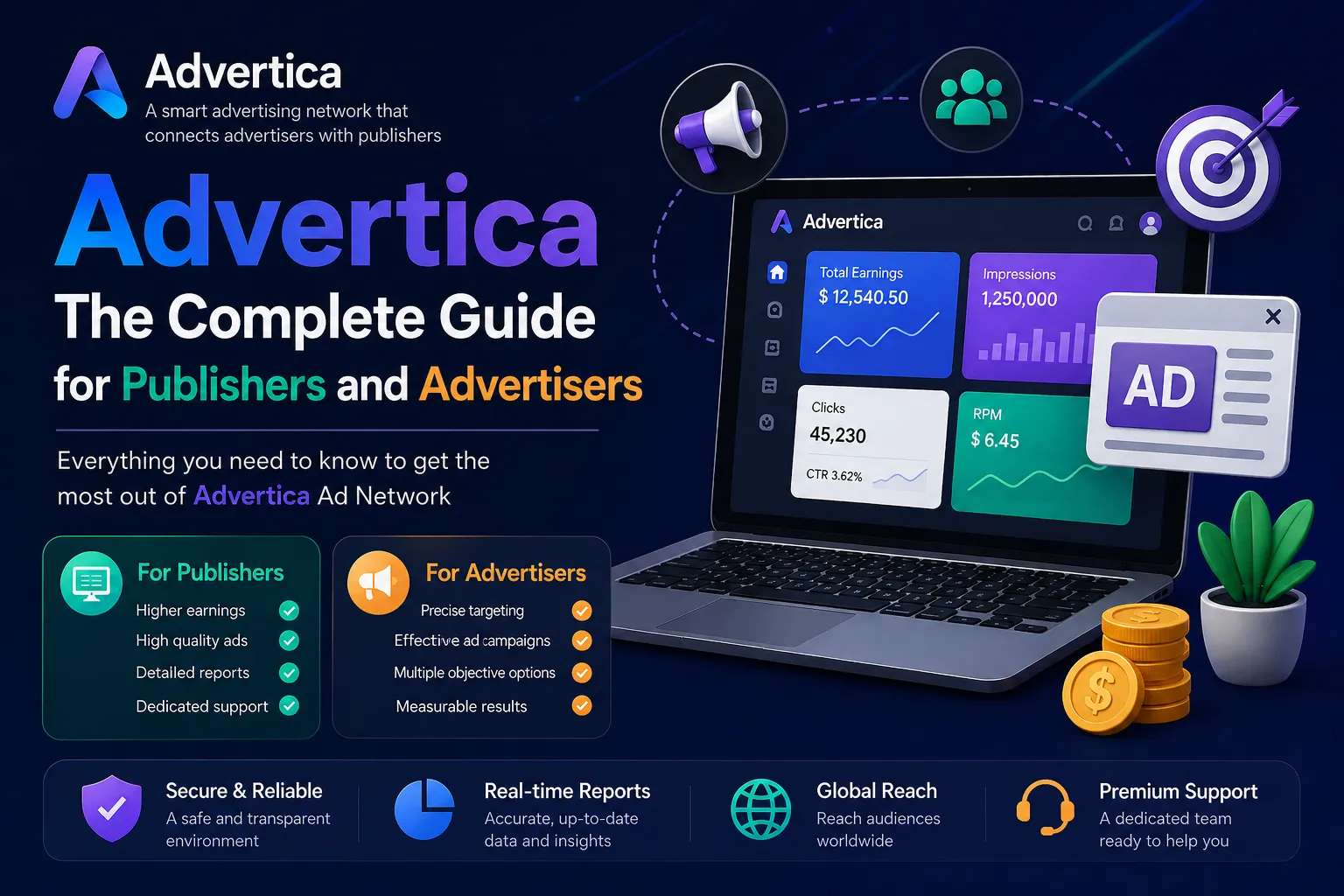
This article provides a thorough, in-depth examination of Advertica, a global digital advertising network that combines instant website approval with access to premium Google AdX demand. You will learn about its origins, developmental phases, available ad formats, pricing models, payment systems, fraud protection, and the best modern practices that enable publishers to maximise their advertising revenue. The article addresses anyone seeking a precise technical and commercial understanding of this steadily growing platform in the global digital advertising market.
1. Introduction: What Is Advertica?
Advertica is a global digital advertising network that serves both publishers — website owners and bloggers — and advertisers seeking to reach targeted audiences around the world. The platform distinguishes itself through a publisher-first philosophy, offering instant website approval with no restrictive constraints on niche or traffic volume. This makes it a compelling destination for new and medium-sized websites looking for reliable advertising revenue sources without the lengthy gatekeeping processes common to larger networks.
What sets Advertica apart in the digital advertising market is its combination of traditional ad formats — such as banners and pop ads — with direct access to Google AdX demand, the premium advertising exchange from Google that is ordinarily available only to large-scale networks and their vetted partners. Publishers who join Advertica gain an exceptional opportunity to monetise their inventory through high-value demand that would otherwise be inaccessible to them directly.
The platform officially reports figures that reflect its maturity and market presence: more than 250,000 publishers and advertisers combined, over $50 million paid out to publishers since its founding, and more than 14 years of experience in the digital advertising industry. These numbers confirm that Advertica is not a newcomer to the space but carries well-established roots, even if it remains smaller in scale than the dominant giants of the sector.
Advertica accepts virtually all website categories, including news sites, blogs, forums, tool sites, and general content platforms. This openness in acceptance policy represents a genuine competitive advantage in a landscape where many networks impose strict niche restrictions or require minimum monthly traffic thresholds that can serve as real barriers for beginner and intermediate publishers who are still building their audiences.
2. Origins and Foundation: How Did It Begin?
Advertica was founded in 2012, as indicated by the copyright notice on its official website, and was legally registered in Slovakia under the name Advertica SK s.r.o. The founding vision was built on a straightforward but deeply significant principle: that publishers deserve fair treatment — the right offers, honest payouts, and on-time payments delivered without delay or unnecessary complexity. This principle continues to define the platform's identity today.
In its formative phase, Advertica concentrated on building a robust affiliate offer network (Affiliate Offers) that allowed publishers to monetise their traffic under the cost-per-action CPA model. This strategy specifically targeted publishers who possessed genuine, high-intent traffic and wanted to convert it into revenue without relying entirely on impression-based advertising. The affiliate model rewarded publishers directly for the real actions users completed on advertiser pages.
The platform quickly expanded to support multiple pricing models — CPM and CPC alongside CPA — which enabled it to accommodate a much broader range of publishers with different site types and traffic profiles. This expansion in pricing flexibility was a pivotal strategic step because it made Advertica accessible to high-volume websites where conversion rates might be modest but impression counts are large enough to generate meaningful CPM-based revenue consistently.
The foundational years also saw significant investment in building relationships with international advertisers of substance. These early commercial partnerships paved the way for the subsequent acquisition of access to Google AdX premium demand, which would become one of the platform's most important differentiating features and the primary reason many publishers choose it as a monetisation partner alongside or instead of more conventional ad networks.
3. Development Phases from 2012 to 2025
Phase One (2012 – 2015): Foundation and Identity Building
This phase was defined by constructing a solid affiliate offer network and developing an accurate in-house tracking platform capable of measuring advertiser campaign performance with transparency. Publisher acceptance during this period involved manual review to ensure quality, though the criteria remained more flexible than those of networks such as Google AdSense. The CPA model that underpinned the network in its early years proved its ability to generate genuine value for both sides of the advertising equation, establishing the trust that fuelled the platform's subsequent growth.
Phase Two (2016 – 2019): Diversification and Expansion
This phase saw the introduction of additional pricing models — CPM and CPC — alongside an expansion of available ad formats to include standard banners, pop ads, and redirect advertising. Concurrent with this was the development of a more professional, feature-rich publisher dashboard providing real-time performance data. Advertica also began during this period to systematically broaden its pool of international advertisers, laying the commercial groundwork for what would become its most significant competitive advantage in later years.
Phase Three (2020 – 2022): Maturity and Google AdX Integration
This phase represents a qualitative leap in Advertica's trajectory. The platform began enabling its affiliated publishers to benefit from Google AdX demand to improve ad inventory fill rates and effective CPM values. Advertica also launched its daily payment option during this period, which rapidly became one of the most compelling reasons publishers chose it over competing networks. The support for multiple cryptocurrencies as withdrawal methods was also introduced, significantly expanding the geographic reach of the platform's payment accessibility.
Phase Four (2023 – 2025): Reputation Consolidation and Sustained Growth
Advertica focused in this phase on reinforcing its market reputation through strict adherence to payment schedules and continuous improvement of the technical support provided to both publishers and advertisers. The platform refined its internal analytics tools, expanded its affiliate offer catalogue, and raised commission values to remain competitive in an increasingly crowded market. Total cumulative payouts to publishers surpassed the $50 million milestone by 2025, a figure the company highlights as a testament to its sustained reliability and scale.
4. Business Model: How Advertica Creates Value for Both Sides
Advertica's business model rests on an integrated system that combines a traditional display ad network with an affiliate marketing network under a single roof. This uncommon combination allows a single publisher to benefit from two distinct revenue streams simultaneously: impression-based CPM and CPC advertising for high-volume traffic, and performance-based CPA affiliate offers for traffic with high purchase intent. Few platforms in the mid-tier market offer both with equal depth.
From a technical standpoint, Advertica operates as an intermediary between publisher and advertiser through an automated auction system that determines the highest available bid for each ad impression in a fraction of a second. Added to this is the demand flowing from Google AdX, which participates in the auction alongside Advertica's internal demand. This dual-demand structure raises the competitive ceiling on the publisher's inventory and theoretically achieves the highest possible price for each impression at every moment of the day.
Advertica maintains a carefully balanced equilibrium between the publisher's interest — achieving the highest possible CPM — and the advertiser's interest — obtaining the best conversion rate at the lowest viable cost. The precise targeting technologies built into the platform contribute to this balance by ensuring each ad reaches the audience most likely to engage with it, which raises genuine conversion rates and justifies the advertiser's decision to increase their budget on the platform with growing confidence over time.
This model creates a virtuous cycle that ultimately benefits the publisher: higher-quality ads produce better click-through and conversion rates, which attracts more advertisers and raises bid values, which in turn translates into higher earnings per impression for the publisher. The quality of the traffic the publisher delivers remains the most critical single variable in this entire ecosystem and the one that publishers have the most direct influence over.
5. Google AdX Access and Its Significance for Publishers
Google Ad Exchange, abbreviated as AdX, is Google's premium advertising marketplace reserved for top-tier publishers and advertisers. AdX surpasses the standard Google AdSense platform available to the general public in one critical dimension: it connects publishers to large institutional advertisers who pay significantly higher rates in exchange for access to quality, verified inventory reaching specific, valuable audiences.
Under normal circumstances, an independent publisher cannot access Google AdX directly without going through a Google-certified publishing partner. Advertica functions as one such channel, granting its affiliated publishers the ability to tap into this premium demand pool that would otherwise be beyond their reach. This represents an exceptional gateway for websites that cannot meet Google's strict direct AdX requirements around traffic volume, content policy compliance, and viewability standards.
Illustrative example: Consider a news website receiving 200,000 monthly visits from Western Europe. By joining Advertica and accessing Google AdX demand, the effective CPM that publisher receives might rise from $1.20 — a typical average for a standard mid-tier network — to $2.50 or higher, because AdX advertisers pay a premium for high-viewability inventory reaching verified, engaged audiences. That difference compounded over twelve months represents a substantial increase in annual publisher revenue from the same traffic.
It is important to note that the actual benefit derived from Google AdX demand depends on several factors: the geographic origin of the traffic, the viewability rate of the ad placements, and the brand safety level of the published content. Websites covering entertainment or grey-area content may not activate the full AdX demand stack. Publishers are therefore advised to ensure their content aligns with Google's advertising policies before relying heavily on AdX-driven CPM improvements as the foundation of their monetisation strategy.
6. Available Ad Formats and Which One Suits Your Site
6.1 Traditional Display Banners
Advertica supports all standard sizes recognised by the Interactive Advertising Bureau (IAB): 300×250 (medium rectangle), 728×90 (leaderboard), 160×600 (wide skyscraper), and 300×50 (mobile banner). These units load quickly, are compatible with all modern browsers and mobile devices, and represent the most universally applicable ad format across virtually every site type. They are the natural starting point for blogs, news sites, and content-rich platforms of any niche.
6.2 Pop Ads (Pop-under and Pop-up)
Pop ads are among the highest-earning formats per impression for high-traffic websites. They work by opening an additional browser window or new tab when the user interacts with the page, generating high impression rates because they do not depend on a user click to trigger. This format is particularly well-suited to websites offering free online tools, file-sharing platforms, and technical forums that attract densely concentrated traffic sessions where users are actively engaged with on-screen tasks.
6.3 Redirect Ads
Redirect ads work by routing the user to an advertising landing page when they arrive at a specific URL or click a designated button. This format consistently achieves some of the highest genuine click-through rates available because the user reaches the advertising page in the context of an intentional interaction they initiated. Redirect ads require careful frequency management, however; used excessively or in unexpected contexts they can damage user experience and erode the trust that sustains long-term audience retention.
6.4 Push Subscription Ads
Push Subscription ads represent a modern ad format built on obtaining the user's permission to receive browser notifications, then delivering targeted advertising messages to them even after they have left the site. This format generates compounding long-term value because the subscriber base accumulates over time, creating a retargetable audience at very low marginal cost per subsequent impression. It is ideally suited to sites with regularly updated content that can provide genuine ongoing value to subscribers beyond the advertisements themselves.
6.5 File Download Monetisation
Advertica offers a format that is relatively rare among ad networks: monetisation of file download pages. This model works by presenting an interstitial advertisement or redirecting the user to an advertising page between the moment they click the download button and the moment the actual download begins. It is ideally suited to websites distributing free software, PDF documents, e-books, templates, and downloadable digital assets, where the user is in a cooperative and patient state of engagement with the site.
7. Pricing Models: CPM, CPC, and CPA
CPM – Cost Per Mille (Cost Per Thousand Impressions)
The CPM model rewards the publisher with a fixed amount for every thousand successful ad impressions served on their site, regardless of whether the user interacts with the advertisement. CPM values in Advertica are determined by multiple variables: the geographic origin of the visitor, the ad format used, the site's content niche, and the overall quality of the traffic. The integrated Google AdX demand meaningfully raises effective CPM values because it adds a premium competitive layer to the auction for every impression.
Calculation example: A website generating 300,000 impressions per month at an effective CPM of $1.80 would earn: 300,000 ÷ 1,000 × 1.80 = $540 per month. This figure rises automatically as traffic quality improves and a greater proportion of visits originate from European and North American markets, which historically command the highest CPM values within the Google AdX ecosystem.
CPC – Cost Per Click
Under the CPC model, the publisher earns a defined amount for each genuine click a user makes on an advertisement. This model suits websites attracting visitors with a high intent to engage — such as review sites, product comparison pages, and buying guides. Advertica employs an internal fraud detection system to verify the legitimacy of each click before registering it, protecting advertisers from invalid traffic while simultaneously ensuring that publishers receive full credit for every authentic user interaction that their content generates.
CPA – Cost Per Action
CPA is the foundational model that originally defined Advertica's identity in the market. It rewards the publisher when a user completes a specific predefined action — such as registering for a service, making a purchase, downloading an application, or filling out a lead form. The platform maintains a catalogue of thousands of affiliate offers from international advertisers, categorised by industry, country, and commission value to simplify the publisher's process of identifying the offers most relevant to their site's audience.
The essential insight for publishers using the CPA model is that content-offer alignment drives everything. A website covering online education will achieve conversion rates dramatically higher with CPA offers for e-learning platforms or professional certification courses than with generic offers disconnected from the site's topic. The publisher who invests time in understanding their audience's intent and matching it to the right offers unlocks the full earning potential of the CPA model on Advertica.
8. Publisher Guide: Joining, Requirements, and Setup
8.1 Registration and Instant Approval
Advertica explicitly advertises a policy of instant website approval for virtually all site categories. In practical terms, this means that the moment you complete registration and add your website to the dashboard, you can retrieve advertising code and begin running ads without waiting days or weeks in a review queue. This stands in deliberate contrast to the approach of networks such as Google AdSense, where the review process can stretch over weeks and may ultimately result in rejection for reasons that are not fully explained to the applicant.
8.2 Acceptance Requirements and Content Restrictions
Despite its openness in acceptance, Advertica enforces restrictions on certain categories of prohibited content that are standard across the reputable digital advertising industry. Websites hosting content involving the exploitation of minors, material inciting violence or hatred, or content promoting strictly controlled substances are categorically ineligible. Websites featuring adult content for legal audiences or grey-area content are subject to additional review that determines which ad formats and demand sources they may access within the platform.
8.3 Technical Integration and Code Retrieval
After approval, the integration process involves retrieving a unique JavaScript code for each ad unit and embedding it in the desired locations across your site's pages. Advertica provides responsive ad units that automatically adapt to the screen dimensions of the viewing device — whether desktop, mobile, or tablet — without requiring separate code for each device type. For WordPress users, third-party plugins compatible with Advertica's code structure simplify the integration process without requiring any manual modification of the site's source files.
8.4 Performance Monitoring and Data Analysis
Advertica's publisher dashboard provides real-time detailed data encompassing: total impressions served, click-through rate (CTR), and daily, weekly, and monthly earnings broken down by ad format and geographic source country. These analytics enable the publisher to identify which traffic sources generate the highest revenue per impression and to direct their content and SEO efforts accordingly — shifting from guesswork to data-informed decision-making grounded in actual performance evidence.
9. Advertiser Guide: Launching a Successful Campaign
9.1 Targeting Configuration and Audience Definition
Advertica provides advertisers with multi-layered granular targeting options to ensure their message reaches the segment most likely to respond. Available targeting parameters include: country and geographic region, device type (desktop, mobile, or tablet), operating system, browser type, device language, and the content niche of the host publisher site. This level of precision empowers advertisers to focus their budget on the highest-value segments without dispersing it across audiences that are statistically unlikely to convert.
9.2 Budget Management and Bidding Strategy
The platform allows advertisers to set a daily total budget alongside a maximum bid cap per pricing model. Advertica provides competitive bid recommendations based on real-time market competition data within each specific targeting segment, helping new advertisers enter with appropriate bids from the outset rather than learning through costly trial and error. It is always advisable to begin with a limited test budget to evaluate campaign performance across different publisher placements before scaling spend on sources that demonstrate genuine conversion.
9.3 The Individualised Optimisation Approach
Advertica emphasises in its stated philosophy that every advertising campaign is unique and demands an individualised optimisation approach. In practical terms, this means the Advertica support team provides professional guidance to advertisers seeking to improve their campaign results, rather than leaving them to navigate the optimisation process entirely independently. This hands-on advisory orientation reduces the time advertisers spend in unprofitable testing phases and accelerates the path to conversion rates that justify sustained or increased investment.
10. Payment Methods and Minimum Withdrawal Thresholds
Advertica operates a comprehensive and flexible payment ecosystem that addresses the needs of publishers across every region of the world. The platform's offer of daily payments is a feature that remains genuinely rare in the ad network industry, where the majority of networks require waiting a week or a full month before releasing earned funds. The payment methods currently available according to the official platform are:
- PayPal: Minimum withdrawal of $5; available in the majority of countries worldwide.
- Payoneer: Minimum withdrawal of $5; widely preferred by publishers across the Middle East and Asia.
- Bank Wire Transfer: For accounts generating substantial monthly earnings that prefer direct bank settlement.
- Bitcoin (BTC): Minimum withdrawal of $5; the preferred option for publishers who favour decentralised transactions.
- Ethereum (ETH): A leading cryptocurrency with moderate transaction fees and broad global liquidity.
- USDT (Tether): A stablecoin pegged to the US dollar that eliminates exchange rate volatility on withdrawal.
- USDC: Another trusted US dollar-pegged stablecoin offering high liquidity and low transfer costs.
- Solana (SOL): A high-speed blockchain network with exceptionally low transaction fees per transfer.
- Dogecoin (DOGE): A widely recognised cryptocurrency with a large user base and low per-transaction costs.
Advertica offers three flexible payment cycles for publishers to choose between: daily, weekly, and monthly. The minimum withdrawal threshold of just $5 is an exceptionally competitive figure in the industry, enabling even new publishers with modest initial earnings to retrieve their funds quickly rather than waiting to accumulate the higher minimums — sometimes $100 or more — that competing networks require before releasing a payment. Most of Advertica's payment methods carry no additional processing fees, ensuring that the amount earned reaches the publisher in full.
The acceptance of multiple cryptocurrencies — particularly the stablecoins USDT and USDC — provides a highly practical solution for publishers in regions where PayPal and Payoneer coverage is limited or restricted. Stablecoins combine the global accessibility and speed of cryptocurrency transfers with the price stability of the US dollar, making them an ideal withdrawal mechanism for internationally distributed publisher communities who need reliable, cost-efficient access to their earned revenue without exposure to the volatility associated with non-pegged cryptocurrencies.
11. Security and Trustworthiness: Evaluating Advertica
Assessing the trustworthiness of an ad network is a necessary step before investing your website's reputation and your time in any monetisation partnership. The independent verification tool Scam Detector assigned advertica.com a trust score of 84.8 out of 100, categorising it with the following attributes: Authentic, Trustworthy, and Secure. This rating was derived from an automated analysis of 53 distinct data points, including the site's technical infrastructure, domain history, privacy policy implementation, and SSL certificate configuration.
The independent platform ScamAdviser confirmed in a separate analysis that publisher.advertica.com is legitimate and safe to use. These positive external validations are reinforced by the company's verifiable legal registration in Slovakia as a formal commercial entity operating continuously for more than a decade. A traceable and sustained legal presence represents an important safeguard in a sector where opaque ad networks occasionally disappear without warning, taking accumulated publisher earnings with them.
On the subject of ad fraud prevention, Advertica employs internal technologies to detect bot-generated traffic and verify the authenticity of clicks and conversions before registering and paying them out. The transparency of the reporting system — through which advertisers can track every conversion with its complete associated details — functions as an internal accountability mechanism that limits the scope for manipulation and builds mutual trust between the two parties of the advertising relationship.
Trustpilot reviews for the platform are mixed, as is common across the CPA network sector broadly. A portion of negative reviews reflect a misunderstanding of how the CPA model operates: some users expect guaranteed earnings analogous to CPM regardless of whether their traffic produces actual user actions. Reviews from publishers who correctly understood and applied the CPA model consistently report receiving payments on schedule and receiving responsive technical support when issues arose.
12. Best Modern Practices for Maximising Revenue
12.1 Selecting Affiliate Offers Aligned with Site Content
The single most important factor in the success of the CPA model on Advertica is organic alignment between your site's content and the nature of the affiliate offer selected. A technology review site will produce conversion rates far superior to a generic site when paired with software or app offers. Publishers are advised to invest meaningful time in browsing the offer catalogue available in the dashboard and selecting offers whose subject matter, geographic targeting, and commission structure genuinely match the profile and intent of their actual audience.
12.2 Combining Pricing Models Strategically Across Pages
There is no requirement to choose a single pricing model; running CPM, CPC, and CPA concurrently across different page types is not only possible but recommended. High-traffic main content pages benefit most from CPM banner placements and pop formats. Focused, topic-specific article pages are better suited to CPA offers that match the article's subject. This page-level differentiation maximises the revenue generated from each part of the site according to the unique audience intent that each page type naturally attracts.
12.3 Raising Viewability Rates to Improve AdX Bid Values
Since Advertica provides access to Google AdX demand, the Viewability Rate of your ad placements — the percentage of ads that genuinely appear within the user's visible screen area — directly influences the bid values received from AdX advertisers. AdX buyers pay a meaningful premium for high-viewability inventory. Placing ad units above the fold, within the body text, and in positions that are not obscured by design elements ensures that your inventory qualifies for and attracts the highest tier of programmatic demand available through the platform.
12.4 Using Daily Payments as a Performance Optimisation Tool
The daily payment feature in Advertica is more than a financial convenience — it is a strategic optimisation instrument. By observing earnings at a daily granularity, you can identify which days of the week, which content types, and which traffic sources generate the highest revenue per impression, then make targeted adjustments to your content strategy and ad configuration based on that evidence. The rapid feedback cycle created by daily payments compresses the learning curve and accelerates the path to a consistently optimised monetisation setup.
13. Advertica Compared to Competing Ad Networks
Advertica vs. Google AdSense
Advertica and Google AdSense differ fundamentally across several key dimensions. AdSense enforces a strict manual review process and rejects many new or niche-diverse websites, while Advertica offers instant approval for virtually all categories. Advertica additionally provides the CPA model, which is entirely absent from AdSense. In practical application, many publishers successfully use both platforms simultaneously — AdSense for primary banner placements and Advertica for supplementary CPA offers and pop formats — creating a diversified revenue structure that reduces dependence on any single network.
Advertica vs. Adsterra
Advertica and Adsterra share meaningful overlap in offering pop ads, banner formats, and CPA opportunities. Adsterra holds an advantage in overall market scale and the innovative Social Bar format, while Advertica's distinctive strengths lie in its direct Google AdX access, its instant approval policy, and its daily payment cycle with a $5 minimum threshold. Publishers operating sites with high-quality, geographically diverse traffic are the most likely to observe a meaningful CPM advantage from Advertica's AdX integration relative to Adsterra's programmatic demand.
Advertica vs. Media.net
Media.net, the ad network affiliated with Yahoo and Bing, operates on a contextual advertising model and delivers its strongest results for English-language websites targeting North American audiences. It requires a majority of English-language traffic and produces significantly weaker results for multilingual or non-English websites. Advertica fills this gap effectively with its acceptance of all languages and geographies, making it consistently the more practical and productive choice for publishers whose sites serve audiences outside the English-speaking world.
Advertica vs. PropellerAds
Advertica and PropellerAds share the pop advertising and CPA affiliate spaces and compete for an overlapping base of publishers and advertisers. PropellerAds holds an advantage in the total scale of its advertiser network and overall impression volume. Advertica differentiates itself through Google AdX access and its daily payment flexibility. Performance comparison between the two varies significantly by site niche and traffic geography. Testing both networks concurrently over a full calendar month and comparing actual figures is always the most reliable basis for a well-informed allocation decision.
14. The Effect of Advertica Ads on Search Engine Optimisation
Google states explicitly in its official documentation that the presence of advertising on a website does not in itself cause search ranking penalties. What does negatively influence ranking is poor user experience caused by advertising. This distinction is practically significant: Advertica ads managed correctly do not harm your site's position in search results. The problem arises exclusively when advertising formats are used excessively or in ways that obstruct users from accessing the content they came to the site to consume.
For the pop ads that Advertica offers, there is an important SEO consideration worth understanding: Google classifies intrusive pop-up and pop-under experiences as a negative user experience signal when they are overused. It is recommended to configure pop ad frequency so that no individual user encounters the format more than once every thirty minutes, and to use the frequency capping controls available in the publisher dashboard to enforce this limit automatically. This prevents the accumulation of negative user experience signals that could, over time, suppress organic search ranking.
Traditional banner ads from Advertica carry a very limited SEO risk, provided that the ad units are optimised for fast loading. Publishers should monitor Core Web Vitals metrics continuously through Google Search Console and verify that any new advertising code does not raise the Cumulative Layout Shift (CLS) metric above the acceptable threshold of 0.1. Ad units that cause the page to shift visually as they load are classified by Google as a poor page experience and receive a corresponding signal in organic search ranking assessments.
The practical conclusion is straightforward: advertising is a normal and accepted part of the internet economy and is not penalised by search engines as such. What search engines penalise is the excessive deployment of advertising that transforms a useful content resource into a frustrating obstacle course for users. Maintain the balance — a reasonable number of well-placed ad units that do not impede content access — and you will find that advertising revenue and strong organic search performance are fully compatible long-term objectives.
15. The Referral Program and Commission Structure
Advertica operates a referral program distinguished by a clearly defined and transparent commission calculation mechanism. The referrer receives 2.5% of the payout amount of every conversion generated by a publisher who joined through their unique referral link. This means the commission is tied directly to the referred publisher's actual performance rather than to their mere registration, which creates a natural incentive for referrers to actively support and guide the publishers they invite. The more successfully the referred publisher monetises their site, the higher the passive commission income the referrer accumulates.
If you are interested in joining Advertica and exploring what its advertising ecosystem has to offer, you can register for free through the following referral link: Join Advertica Now — registration is entirely free, approval is instant, and you can have your first ad units running within minutes of completing the signup process.
The referral program is a particularly well-suited opportunity for those who operate educational blogs, monetisation-focused YouTube channels, or online communities centred on web publishing and passive income strategies. By providing an honest, well-researched review of the platform to your audience and directing interested readers through your referral link, you build a compounding passive income stream that grows in direct proportion to the success of the publishers you bring to the network — with no additional effort required once the initial referral is made.
16. Advantages and Disadvantages: An Objective Assessment
Advantages
- Instant approval: No waiting period, no arbitrary rejection — you can begin monetising from day one of registration.
- Google AdX access: A rare capability for small and medium-sized sites that meaningfully raises effective CPM values.
- Daily payments with a $5 minimum: Superior to most competitors in the speed and accessibility of earnings retrieval.
- Multiple ad formats in one platform: Banners, pop ads, redirects, push subscriptions, and file download monetisation under a single dashboard.
- Extensive cryptocurrency support: Nine payment methods including five cryptocurrency options provide genuine global reach.
- Integrated CPA affiliate network: No need to join a separate affiliate platform — offers and display ads coexist in one account.
- 24/7 email support: Technical assistance available around the clock every day of the year.
- Verified payment history: Over $50 million paid to publishers since founding, publicly acknowledged and consistently cited.
Disadvantages and Caveats
- Network scale: Smaller in overall advertiser volume than industry giants such as AdSense and PropellerAds, which may affect CPM rates in certain niche markets.
- Mixed Trustpilot reviews: Some negative feedback stems from misunderstanding the CPA model rather than from genuine platform failures, but the mixed signal is worth acknowledging.
- CPA requires active optimisation: The CPA model does not generate income automatically; it demands careful offer selection and ongoing performance monitoring to produce meaningful results.
- Limited public volume data: Advertica does not publish detailed figures on monthly impression volume, making direct pre-join comparisons with competitors more difficult for prospective publishers.
17. Summary and Conclusions
Advertica has covered considerable ground since its founding in 2012 to establish itself today as a trustworthy advertising platform that delivers genuine value to publishers and advertisers alike. The platform brings together a rare combination that is difficult to replicate in the mid-tier market: instant approval with no rigid barriers to entry, integrated access to Google AdX premium demand, and a daily payment system with an exceptionally low minimum threshold of just five dollars.
Advertica is a strategically sound choice for three distinct publisher profiles. The first is the new publisher who needs fast acceptance and immediate revenue without overwhelming requirements. The second is the intermediate publisher who wants to diversify their monetisation beyond a single network and add a CPA dimension alongside their existing display advertising income. The third is the publisher operating a high-quality niche site who wants to capture the CPM premium available through Google AdX without meeting the stringent direct access requirements that Google itself imposes.
The core recommendation this article offers to any publisher considering Advertica is this: do not evaluate the platform on the basis of a one- or two-week trial. CPA advertising requires time to optimise and to build the understanding of your audience's intent and its alignment with available offers. Give the platform a genuine trial of at least one month, invest time in selecting offers well-matched to your content, and monitor the data consistently. The system rewards effort and informed decision-making with results that accumulate progressively rather than arriving instantly.
To get started immediately, register for free with Advertica through the referral link below: https://adv.so/378367 — discover for yourself the earning potential that your site's traffic genuinely holds when paired with the right combination of ad formats, pricing models, and premium demand sources.
18. References and Sources
- Advertica Official Website — Official information on the platform's ad formats, payment methods, and publisher performance statistics.
- Advertica Help Centre — Official technical documentation and step-by-step guides for publishers and advertisers.
- Interactive Advertising Bureau (IAB) — Internationally recognised standards for ad formats, sizes, pricing models, and industry terminology.
- Core Web Vitals – web.dev — Google's official documentation on the user experience metrics that influence organic search rankings.
- Google PageSpeed Insights — A free diagnostic tool for measuring site loading performance and verifying the impact of advertising code on page speed.
- Scam Detector – Advertica Trust Assessment — An independently verified trust score of 84.8 out of 100 confirming the platform's legitimacy and operational safety.
- Statista – Digital Advertising Statistics — Verified statistics and research reports on global digital advertising market size, growth trajectories, and spending forecasts.
- Google AdSense Policy: User Experience and Advertising — The official Google documentation clarifying how advertising affects site ranking and what constitutes a policy violation.